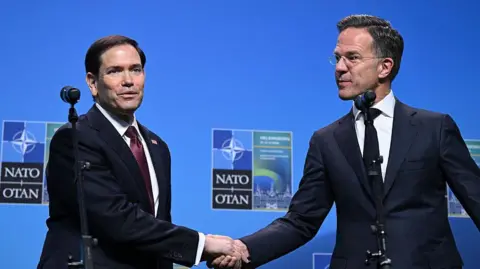
US Secretary of State Marco Rubio has made a urgent diplomatic effort to reassure NATO allies over conflicting announcements about US military deployments in Europe, following President Donald Trump's contradictory decisions on troop movements. During a press conference in Sweden after a NATO foreign ministers' meeting, Rubio addressed the turmoil sparked by Trump's announcement of sending 5,000 additional troops to Poland—a reversal of a previous cancellation of a 4,000-troop deployment and days after withdrawing 5,000 troops from Germany.
'US troop presence in Europe is constantly being reevaluated based on global commitments, and this work was done in coordination with our allies,' Rubio stated, acknowledging allies' unease while asserting the adjustments are 'well understood' within NATO. The announcement followed Trump's Truth Social post citing his close relationship with Polish President Karol Nawrocki, whom he backed during elections and who has been a consistent supporter of Trump's policies. Yet Trump provided no clarity on whether the new deployment was part of the canceled operation or a separate initiative.
The confusion deepened during Sweden's NATO summit, where Swedish Foreign Minister Maria Malmer Stenergard described the situation as 'confusing indeed, and not always easy to navigate.' Rubio defended the shifts as necessary but conceded, 'I'm not saying they're going to be thrilled about it, but they certainly are aware of it.' The announcements coincided with Trump's broader push to reduce US military presence in Europe under his 'America First' agenda, particularly after the US withdrew troops from Germany following tensions with Chancellor Friedrich Merz over the Iran conflict.
The move has raised alarms amid NATO's critical role in Europe's security since Russia's invasion of Ukraine in 2022. The US maintains the largest military footprint in the alliance, with over 36,000 troops in Germany, 12,000 in Italy, and approximately 10,000 in Poland and the UK. However, as Trump increasingly questions NATO's value to American interests, NATO Secretary General Mark Rutte warned that 'the trajectory towards Europe becoming less reliant on the US will continue.'
Rubio underscored the dual demands on NATO during his remarks: 'I understand NATO is valuable to Europe, and it should be. It also has to be valuable to the United States.' The conflicting troop decisions reflect growing fractures in the alliance, with European nations now grappling with how to balance US strategic shifts against their own security needs. With US military presence shifting closer to Russia's borders while withdrawing from established hubs, NATO members face unprecedented challenges in maintaining unity during a volatile geopolitical moment.}
'US troop presence in Europe is constantly being reevaluated based on global commitments, and this work was done in coordination with our allies,' Rubio stated, acknowledging allies' unease while asserting the adjustments are 'well understood' within NATO. The announcement followed Trump's Truth Social post citing his close relationship with Polish President Karol Nawrocki, whom he backed during elections and who has been a consistent supporter of Trump's policies. Yet Trump provided no clarity on whether the new deployment was part of the canceled operation or a separate initiative.
The confusion deepened during Sweden's NATO summit, where Swedish Foreign Minister Maria Malmer Stenergard described the situation as 'confusing indeed, and not always easy to navigate.' Rubio defended the shifts as necessary but conceded, 'I'm not saying they're going to be thrilled about it, but they certainly are aware of it.' The announcements coincided with Trump's broader push to reduce US military presence in Europe under his 'America First' agenda, particularly after the US withdrew troops from Germany following tensions with Chancellor Friedrich Merz over the Iran conflict.
The move has raised alarms amid NATO's critical role in Europe's security since Russia's invasion of Ukraine in 2022. The US maintains the largest military footprint in the alliance, with over 36,000 troops in Germany, 12,000 in Italy, and approximately 10,000 in Poland and the UK. However, as Trump increasingly questions NATO's value to American interests, NATO Secretary General Mark Rutte warned that 'the trajectory towards Europe becoming less reliant on the US will continue.'
Rubio underscored the dual demands on NATO during his remarks: 'I understand NATO is valuable to Europe, and it should be. It also has to be valuable to the United States.' The conflicting troop decisions reflect growing fractures in the alliance, with European nations now grappling with how to balance US strategic shifts against their own security needs. With US military presence shifting closer to Russia's borders while withdrawing from established hubs, NATO members face unprecedented challenges in maintaining unity during a volatile geopolitical moment.}