In brief
The relationship between China and Russia has been termed a 'friendship with no limits', characterized by deep economic ties, shared political interests, and a strategic alliance against Western influence. However, this partnership also reveals significant asymmetries, with China often dictating terms. The article delves into the nuances of this relationship, exploring past interactions and future implications for both countries amidst a shifting global landscape.
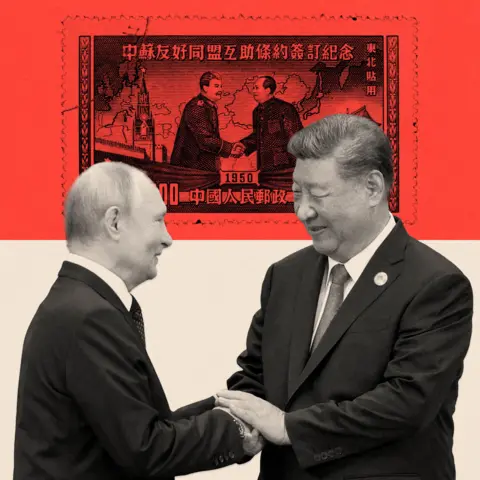
As they strolled through Tiananmen Square in Beijing last September, Chinese President Xi Jinping and Russian President Vladimir Putin appeared to muse over the possibility that organ transplants could dramatically extend human life. Putin's interpreter was heard saying, 'Human organs can be continuously transplanted. The longer you live, the younger you become, and even achieve immortality.' Xi's interpreter responded, 'Some predict that in this century, humans may live up to 150 years old.' This was a rare insight into what is quite a misunderstood partnership, showcasing their camaraderie as strongmen who have described each other as best friends after almost four decades in power. Putin's upcoming visit to Beijing serves as a reminder of their shared interests as they celebrate 25 years of cooperation marked by the Treaty of Good-Neighbourliness and Friendly Cooperation. The stark contrast between Trump's elaborate receptions and Putin's muted visits highlights the unique yet understated dynamics of Sino-Russian relations. Analysts note that the economic relationship is heavily skewed in favor of China, with Russia's dependency on Chinese technology and trade deepening, especially post-Ukraine invasion when over 90% of sanctioned tech is sourced from China. Despite these imbalances, Russia maintains a desire for parity within this alliance, fearing being viewed as a junior partner.Both nations are united against a common perception of Western hegemony and human rights criticisms that they overlook in their bilateral interactions. A closer look reveals that, while their partnership has been termed resilient, it is not a formal alliance but rather a flexible relationship that allows both leaders to navigate their national interests independently. The interconnectedness of their societies, bolstered by mutual visa allowances and increasing trade, underscores a relationship that, despite historical complexities and modern-day pressures, remains integral to both countries' strategic objectives.As China moves cautiously amidst global tensions, the evolutionary nature of this relationship suggests that despite their differences, cooperation will remain vital for both countries, especially as they look beyond Western ties towards a future deeply intertwined with each other.