In brief
UK universities are rapidly establishing campuses in India to tap into the vast market of quality education. The University of York plans to recruit 270 students for its Mumbai campus, while others like the University of Southampton have already opened their doors in Delhi. Despite the high demand for university placements in India, concerns remain regarding the financial sustainability of these campuses and the ability to maintain UK academic standards. The success of these ventures will depend on various factors, including collaboration with local industries, navigating regulatory frameworks, and expanding infrastructure to accommodate increasing student numbers.
On the shores of Mumbai's Powai lake - a rare pocket of serenity in the bustling metropolis of more than 20 million people - a glitzy new campus of the University of York is getting its final finishing touches.
The institute has begun recruiting students for the 2026-27 academic year, and operations are set to commence in the next few months.
We're looking at an intake of around 270 students in the first year... and that should go up to 3,000-4,000 students each year over the coming years, Lindsay Oades, provost of the University of York in Mumbai, told the BBC.
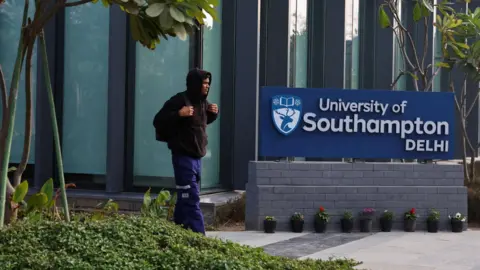
York is among nine UK universities that are setting up campuses in India following announcements last year during Sir Keir Starmer's visit to the country. Others include the University of Aberdeen, University of Bristol, University of Liverpool, Queen's University Belfast, and Coventry University. The campus of the University of Southampton has already opened in Delhi.
Most of these planned campuses are expected to focus primarily on business, management, and engineering programmes. In 2020, India's National Education Policy announced that foreign universities would be allowed in the country, and rules were notified in 2023, creating a legal mechanism for these institutions to set up shop.
Ostensibly, the proposition appears like a win-win for UK universities facing severe fiscal pressures at home, as well as for Indian students starved of quality education locally. However, expanding on the ground will be easier said than done.
According to UK government's figures, India has 40 million university students and would need at least 70 million places in the decade to 2035, presenting a significant market opportunity for British universities.
However, maintaining UK academic standards while operating at Indian price points will require cost discipline and programme selectivity, says Aritra Ghosal of OneStep Global.
While the initial enrolment numbers are expected to be modest, significant growth is anticipated over a five-to-seven-year horizon as alumni outcomes become visible and employer acceptance for these students stabilizes.
The success of this venture will also depend on how well UK universities can adapt to the Indian education landscape, which includes navigating regulatory complexities and developing infrastructure to support surging student demands.
As UK universities continue their push into India, observers will be keenly watching to see if these international campuses can truly meet the challenges and aspirations of Indian students.