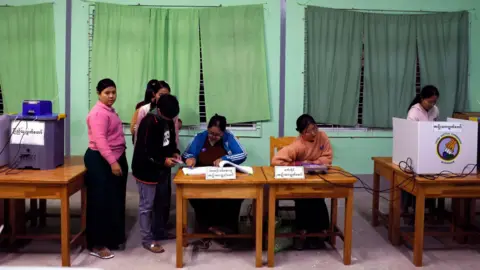
Myanmar is voting in an election widely dismissed as a sham, with major political parties dissolved, many of their leaders jailed and as much as half the country not expected to vote because of an ongoing civil war.
The military government is holding a phased ballot nearly five years after it seized power in a coup, which sparked widespread opposition and spiraled into a civil war.
Observers say the junta, with China's support, is seeking to legitimise and entrench its power as it seeks a way out of the devastating stalemate.
More than 200 people have been charged for disrupting or opposing the polls under a new law which carries severe punishments, including the death penalty.
Polling began on Sunday after reports of explosions in at least two regions of Myanmar.
Three people were taken to hospital following a rocket attack on an uninhabited house in the Mandalay region in the early hours of Sunday, the chief minister of the region confirmed to the BBC.
Separately, more than ten houses were damaged in the Myawaddy township, near the border with Thailand, following a series of explosions late on Saturday.
A local resident told the BBC that a child was killed in the attack, and three people were taken to hospital in an emergency condition.
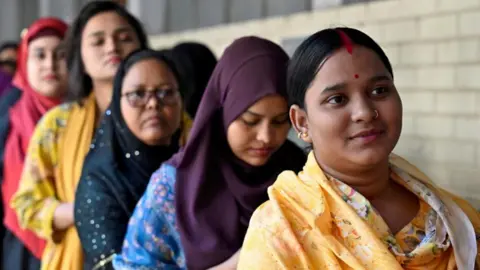
Voters have told the BBC that the election feels more 'disciplined and systematic' than those previously. 'The experience of voting has changed a lot,' said Ma Su ZarChi, who lives in the Mandalay region.
The Burmese junta has rejected criticism of the polls, maintaining that it aims to 'return [the country] to a multi-party democratic system'. After casting his vote at a highly fortified polling station in the capital, junta chief Min Aung Hlaing told the BBC that the election would be free and fair.
Earlier this week, he warned that those who refuse to vote are rejecting 'progress toward democracy'.
The civil war has killed thousands of people, displaced millions more, destroyed the economy and left a humanitarian vacuum. A devastating earthquake in March and international funding cuts have made the situation far worse.
With large parts of the country under opposition control, voting will take place in phases across 265 of the 330 townships, with results expected around the end of January. However, many citizens remain skeptical about the legitimacy of this electoral process.