Votes are being counted in Bangladesh after its first election since student-led protests ousted prime minister Sheikh Hasina in 2024.
More than 2,000 candidates are vying for 300 elected seats in parliament, though none from the banned Awami League of Hasina, who fled after 15 years in power following a brutal security crackdown where hundreds of protesters were killed.
The election pits the centre-right Bangladesh Nationalist Party (BNP) against a coalition led by the Islamist Jamaat-e-Islami, which joined forces with a party born out of the student uprising.
Results are expected on Friday, and there’s widespread hope among voters for a return to democracy.
For the first time since 2008, the outcome of an election in Bangladesh cannot be predicted with certainty. Previous elections were heavily criticized as rigged in favor of Sheikh Hasina.
Hasina, currently exiled in India, faces a death sentence in absentia for abuses during her regime, including a crackdown resulting in the deaths of up to 1,400 protesters according to UN reports.
This election is seen as a significant shift, as many voters express feeling they have a choice.
With over 120 million eligible voters, significant attention is on the constitutional changes proposed by the interim government aimed at reforming the political system.
Interim leader Muhammad Yunus, a Nobel laureate, declared that the election marks the end of a dark chapter and the beginning of a brighter future.
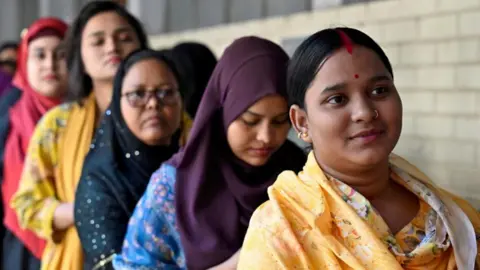
Voter turnout had reached 49% by early afternoon local time, as security remains tight with nearly a million police and soldiers deployed.
Candidates from various historical parties including BNP and Jamaat-e-Islami aim to rally support, while concerns linger regarding representation of women in this election.