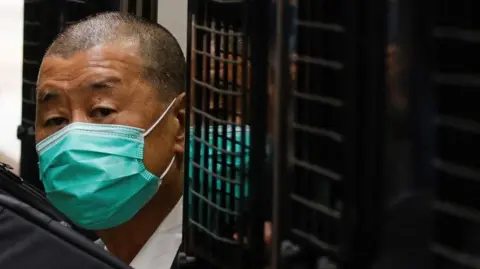
Jimmy Lai, Hong Kong's pro-democracy media tycoon, has been jailed for 20 years for colluding with foreign forces under the city's controversial national security law. Rights groups have described the sentencing as effectively a death sentence for the 78-year-old, raising concerns about his health. In contrast, Hong Kong's leader expressed that the ruling was 'deeply gratifying'. This sentence marks the most severe penalty imposed under the national security law, instituted by China following widespread protests in 2019 aiming for greater freedoms, which the government claims is essential for maintaining stability in Hong Kong.
Lai, a British citizen, is the most high-profile individual among the hundreds arrested under this law. A vocal critic of China, he has leveraged his media platform, Apple Daily, to advocate for democratic values. His son, Sebastien, criticized UK Prime Minister Keir Starmer's recent visit to China, labeling it a missed chance to advocate for his father's freedom, emphasizing the profound ramifications of Lai's imprisonment on the judicial landscape in Hong Kong.
Responses to the verdict have been mixed, with Hong Kong authorities defending the ruling, stamping it as an affirmation of the city’s legal process. Meanwhile, international bodies and human rights organizations have condemned the ruling, labeling it a draconian measure aimed at curtailing free speech and independence in the territory. Calls for worldwide intervention to secure Lai's release have increased, stressing the importance of safeguarding press freedoms globally.
Lai, who has been imprisoned for over five years for various convictions including fraud and unauthorized assemblies, remains a symbol of the fight for democracy in Hong Kong. His case underscores the Chinese government's strategy to stifle dissent and silence oppositional voices through legal and judicial means. As the global community watches closely, the implications of this decision extend beyond Lai, reflecting the broader struggle for human rights in Hong Kong.
Lai, a British citizen, is the most high-profile individual among the hundreds arrested under this law. A vocal critic of China, he has leveraged his media platform, Apple Daily, to advocate for democratic values. His son, Sebastien, criticized UK Prime Minister Keir Starmer's recent visit to China, labeling it a missed chance to advocate for his father's freedom, emphasizing the profound ramifications of Lai's imprisonment on the judicial landscape in Hong Kong.
Responses to the verdict have been mixed, with Hong Kong authorities defending the ruling, stamping it as an affirmation of the city’s legal process. Meanwhile, international bodies and human rights organizations have condemned the ruling, labeling it a draconian measure aimed at curtailing free speech and independence in the territory. Calls for worldwide intervention to secure Lai's release have increased, stressing the importance of safeguarding press freedoms globally.
Lai, who has been imprisoned for over five years for various convictions including fraud and unauthorized assemblies, remains a symbol of the fight for democracy in Hong Kong. His case underscores the Chinese government's strategy to stifle dissent and silence oppositional voices through legal and judicial means. As the global community watches closely, the implications of this decision extend beyond Lai, reflecting the broader struggle for human rights in Hong Kong.