Hezbollah has increased its use of small first-person view (FPV) drones to attack Israel, including systems controlled by fibre-optic cables to evade sophisticated defences.
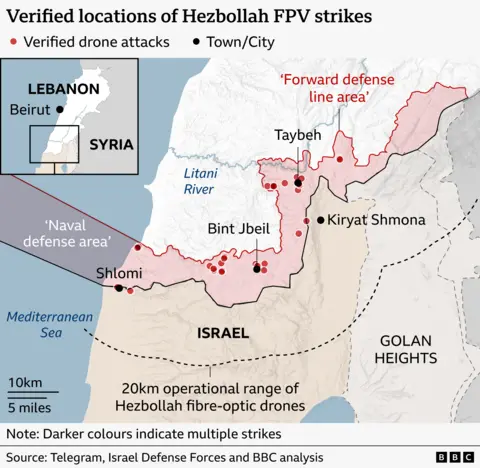
BBC Verify has geolocated 35 videos shared by the Lebanese armed group since 26 March which show strikes on Israeli soldiers, armoured vehicles, and air defense systems in southern Lebanon and northern Israel.
Experts told BBC Verify the Israel Defense Forces (IDF) has so far been unable to develop any effective countermeasures, as the small drones can easily bypass detection systems.
The drones can also be made from commercially available and 3D-printed components - and are cheap compared to the high-value targets they can destroy, experts also said.
The use of cheap FPV drones has become widespread during the Russia-Ukraine war and has fundamentally altered modern warfare.
While the Israeli military has not published all casualty details, Israeli media reports indicate four IDF soldiers and one civilian have been killed in FPV strikes, with dozens more injured.
The IDF told BBC Verify it recognizes the threat from drones and is investing significant resources in improving defenses, developing more effective alert models and training soldiers for improving readiness and increasing awareness of the threat.
According to the Institute for National Security Studies, the IDF has also been using FPV drones for several years, currently operating with them in southern Lebanon and against Hamas in Gaza.
Hisham Jaber, a military analyst and former Lebanese army general, told BBC Arabic the FPV drones can be undetectable by radar, and the hundreds of them at Hezbollah's disposal have been used to disable armoured vehicles - including tanks.
Hezbollah has been using several types of larger attack drones against targets in northern Israel for many years, Jaber added, but the use of FPVs represents an entirely different category.\
BBC Verify has found videos of nearly 100 apparent FPV attacks shared on Hezbollah's Telegram channel since 26 March, 35 of which have been verified.
Hezbollah does not appear to have shared any footage of similar strikes from the conflict, which began on 2 March.
One verified video shared on Thursday shows at least four FPV drones attacking an Israeli border outpost near Kiryat Shmona, targeting a series of military vehicles in sequence. At least two of them can be seen heavily damaged or destroyed in the footage.
Many of these drones are flown using fibre optic cable connections - rather than radio or other wireless signals - making them difficult to intercept with current Israeli electronic counter-measures.
Dr Andreas Krieg, a security expert from King's College London, told BBC Verify the fibre-optics render Israel's capacity to detect, jam and intercept drones largely irrelevant, and makes finding the operator significantly more challenging.
The impact of this, he said, is Israeli troops having to move more cautiously, harden positions, use physical protective measures such as nets and cages, and devote more attention to immediate local defence.
Krieg added Hezbollah is most likely assembling the drones locally from commercially available components sourced from places like China, at a cost in the range of $300-$500 (£225-£375) each.
Leone Hadavi, a senior investigator and weapons expert for the Centre for Information Resilience, stated that these commercial parts are also supplemented with components made using 3D printers.
Hadavi indicated that tracing components has proven difficult due to their accessibility and non-military nature. Mostly these FPV drones carry a rocket-propelled grenade (RPG) warhead, of which there is no shortage in southern Lebanon.
The psychological implication of increasing FPV strikes appears to be significant on Israeli troops, given their capacity to threaten highly protected armoured vehicles.
This recent escalation in fighting between Israel and Hezbollah began on 2 March, two days after the US and Israel launched a wave of air strikes in Iran, killing supreme leader Ayatollah Ali Khamenei.
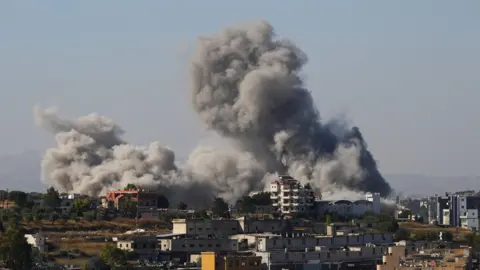
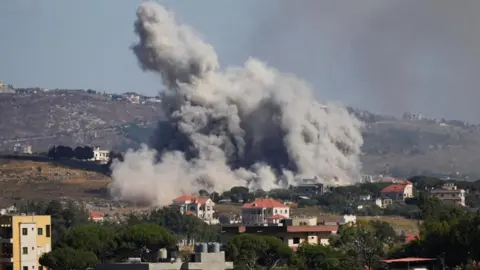
Following Khamenei's death, Hezbollah fired rockets into Israel - and Israel responded with widespread air strikes in Lebanon and a ground invasion of the south of the country.
Lebanon's health ministry has reported at least 2,896 people have been killed since, including more than 400 since US President Donald Trump announced a ceasefire in April. The health ministry's figures do not separate out combatant and civilian deaths.
More than one million people have been displaced in Lebanon since the conflict began.
Israel states that four soldiers and 18 civilians have been killed in the conflict.