In brief
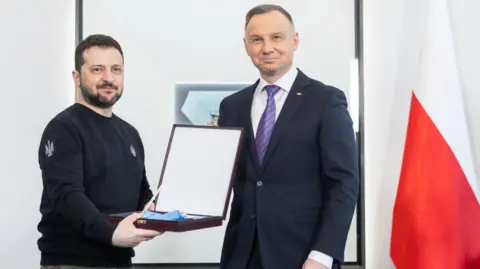
Polish President Karol Nawrocki revoked Volodymyr Zelensky’s Order of the White Eagle following Ukraine’s decision to name a new military unit after the Ukrainian Insurgent Army (UPA). The UPA is viewed by many Ukrainians as national heroes, while Poland cites the 1943‑45 genocide of ethnic Poles. Despite the rupture, Warsaw states it will not affect support against Russia. Ukraine’s foreign minister condemned the decision as a strategic mistake, and Zelensky is expected to return the honour. The row underscores conflicting historical narratives and Ukraine’s EU aspirations.
Volodymyr Zelensky, Ukraine’s president, was stripped of Poland’s top civilian award – the Order of the White Eagle – after Kyiv decided to name a newly formed combat unit after the Ukrainian Insurgent Army (UPA). The UPA, active in the 1940s and 1950s, is seen by many Ukrainians as a heroic resistance force against both the Soviet Army and the Nazis. Warsaw, however, condemns the group as responsible for the 1943‑45 Volhynia massacres in which an estimated 100,000 ethnic Poles were killed. Polish President Karol Nawrocki called the decision “outrageous”, “incomprehensible” and “deeply disappointing”.
Despite the acrimonious tone, Nawrocki assured that this diplomatic row would not jeopardise Poland’s aid to Ukraine against Russia. He stressed that a truly united Europe “cannot accept” those who do not confront their own totalitarian past.
Ukraine’s Foreign Minister Andrii Sybiha slammed the move as a “strategic mistake” and a sign of disrespect, while pointing out the potential benefits for Moscow. He said that the name of the UPA unit “is meant to restore historical traditions of the national army” and that “no president of another country will dictate our history to us.”
Zelensky has remained silent on the matter, but Sybiha announced that he would return the Polish award and that Ukraine would continue its European Union membership negotiations. The row has highlighted the deeper rift over WWII history and the divergent ways that post‑communist societies remember the past.