In brief
Ukrainian soldiers are facing unprecedented challenges at the front lines of the war, particularly in the dangerous area surrounding Kostyantynivka. This report delves into the experiences of a soldier named Kenya, who spent 225 days in combat, highlighting how drones now dominate warfare, requiring rapid adaptations and putting soldiers in perilous situations. As Russia's advance seeks to capture critical regions, the role of ground troops remains crucial in holding Ukrainian territory.
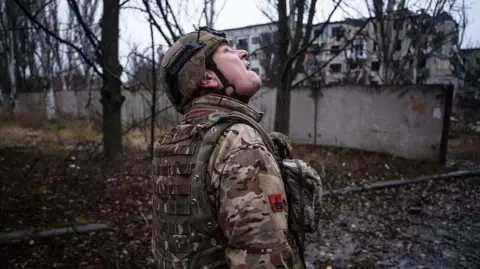
After 225 days stuck in a front-line foxhole, the Ukrainian infantryman's muscles were so weak he could barely walk. His commanders had tried five times to swap him with another soldier, but they could never reach him. Rotating soldiers on the front line in eastern Ukraine is extremely difficult because of the constant threat of drones.
This area near Kostyantynivka is currently one of the most dangerous hotspots, and the Ukrainian military admits that Russian forces have reached its outskirts. Known as Kenya, the infantryman took two days to walk 11km (6.8 miles) to get back to his brigade, avoiding mines and hiding from drones to get out.
Ukraine's 93rd brigade has the job of defending Kostyantynivka and its surrounding towns and villages from Russia's advance. If this highly strategic city falls, Moscow will be able to push towards Kramatorsk and Sloviansk from the north, east, and south. Vladimir Putin sees the Donbas's capture as Russia's 'priority goal,' and Ukrainian intelligence suggests a major Russian offensive might be imminent.
However, Russia's recent gains have stalled significantly. Moscow gained only half as much territory in the Donbas in April as in March. At the same time, Kenya's task has been to maintain his position and listen for any movements outside, engaging only if Russian troops attempt to advance.
Kenya's experiences reflect the changes in modern warfare where most fighting is now carried out by drones. These machines allow armies to conduct operations with precision but have also transformed how ground troops function in combat. Without boots on the ground, however, no territory can truly be controlled. Thus, soldiers like Kenya, who can mark territory while avoiding detection, play an essential role.
As the situation evolves, the Ukrainian military's strategy involves countering Russian logistics and reinforcing defensive positions. Despite the technological advances and challenges posed by drones, the value of front-line soldiers remains paramount in securing Ukrainian territory and resistance against ongoing threats.