China is winning one AI race, the US another - but either might pull ahead
In the second half of the 20th Century, the nuclear arms race preoccupied the brightest minds in the US and the Soviet Union. Today, the US finds itself in a different competition, aiming to dominate technological advancements, particularly in Artificial Intelligence (AI). This pivotal battle unfolds across research labs, universities, and start-ups, drawing the attention of government leaders and major corporations, with expenditures reaching trillions of dollars.
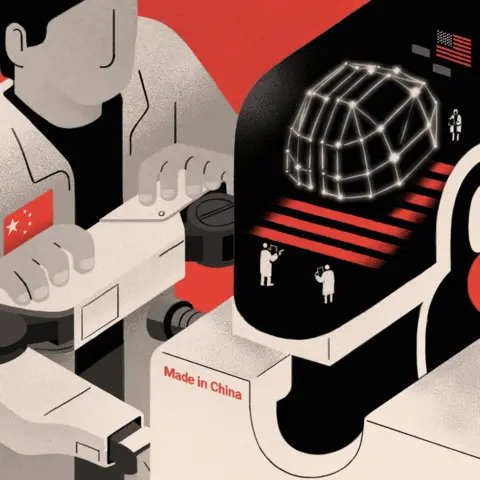
Experts like Nick Wright from University College London observe that the current struggle is characterized by a bifurcation of strengths: the US has historically excelled in AI 'brains'—encompassing chatbots, microchips, and large language models (LLMs)—while China has demonstrated superiority in AI 'bodies', notably humanoid robots that resemble humans. However, as both sides race not to let their rival take the lead, these initial advantages may be challenged in the coming years.
The Battle for LLM Dominance
On November 30, 2022, OpenAI introduced ChatGPT, a chatbot that sparked widespread excitement in the tech community. Experts recognize that the US has currently secured the lead with LLMs, with claims of over 900 million weekly users of ChatGPT. Meanwhile, other American firms like Anthropic and Google invest billions to develop competitive LLMs.
American strategists are concerned with how this technological arms race impacts its standing against China. A senior US official notes that America's strategic edge rests on its hardware capabilities, particularly in microchips, which are predominantly controlled by the US, notably through companies like Nvidia. Strict export controls prevent China from acquiring these advanced chips.
The DeepSeek Counter-Attack
In January 2025, amidst shifts in US political leadership, China launched its own AI chatbot, DeepSeek, which quickly gained traction and proved to be a formidable competitor to American LLMs like ChatGPT, but at a significantly lower cost. This development sent shockwaves through the US market, leading to a record loss in Nvidia's stock value. Experts argue that the restrictive policies of the US were inadvertently pushing China towards self-reliance, fostering rapid advancements in its AI capabilities.
China's Advantage in the Robot Wars
China excels in manufacturing and deploying AI "bodies," heavily investing in robotics technology over the past decade. By incentivizing the development of robotics, the country has established a significant lead in the global robotics market. Reports indicate that China has developed a range of humanoid robots and has focused on using them to address labor shortages caused by an aging population.
The Ghost in the Machine
While China leads in producing robots, it still relies on American technology for the AI brains needed to power these machines. Innovations from US firms in agentic AI—an AI capable of performing complex tasks—still grant the United States a critical advantage in the overall AI landscape.
Who Will Triumph?
It remains uncertain who will ultimately win this race, as experts suggest that victory will not be immediate or distinct but rather a matter of sustained advantage, including effective integration of AI across economies. Both countries are racing towards a future that could lead to divergent societal structures governed by different interpretations of technology implementation, leaving many questions unanswered concerning the implications for global dominance in the 21st century.