In brief
China's economy, already affected by previous trade tensions and slow growth, is now grappling with the repercussions of the US-Iran war. Manufacturing workers face dwindling job prospects and stagnant wages, while industry leaders express concerns over rising production costs. The government calls for an end to the conflict, fearing lasting damage to its crucial export-driven economy.
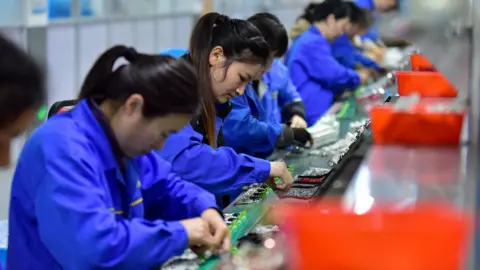
It's a sombre gathering in the backstreets of one of China's biggest manufacturing hubs, with workers struggling as the ongoing US-Iran conflict takes a toll on their livelihoods.
No-one understands what our life is like, shares a factory worker, voicing the frustrations prevalent among those in Foshan, where job opportunities in manufacturing are sparse.
China had shown resilience in the face of previous economic challenges, including tariffs imposed by the Trump administration, reporting GDP growth around 5%. However, the escalation of the Middle East conflict is now undermining that stability.
As the war disrupts the global supply chain, thousands of workers are left anxiously awaiting orders that seem less forthcoming. With many factories reducing their workforce or cutting hours, the fear of unemployment looms large.
In Guangdong province, job advertisements offer meager wages of 18 to 20 yuan per hour for grueling factory work, prompting frustration among seasoned workers who are over 40 and seeking more stable employment elsewhere.
The conflict has escalated production costs sharply, increasing by about 20%, leaving workers and traders grappling with diminishing returns.
Workers in Guangzhou express resignation as they navigate daily challenges, facing stagnant wages while the nation struggles to promote its robust electric vehicle (EV) market amid disrupted trade routes.
Despite these issues, there remains a sense of optimism in China's efforts to present a façade of stability. The country is showcasing technological advancements and drawing international attention at events like the Canton Fair, hoping to attract buyers beyond the Middle East as economic relations shift.
With voices calling for a ceasefire, China is attempting to position itself as a peacemaker, eager to stabilize not only its own economy but also the geopolitical landscape.