In brief
Chinese artist Gao Zhen, known for his satirical sculptures of Mao and religious figures, was arrested in 2024 and now faces trial on charges of 'insulting revolutionary heroes'. His case highlights a severe crackdown on artistic freedom under the current Chinese regime, where even historical art can evoke harsh repercussions.
In the midst of a global conversation around artistic freedom, the recent arrest of Chinese sculptor Gao Zhen has prompted alarm regarding the extreme censorship practices in China. His arrest came in mid-2024 at his studio near Beijing, where he was detained along with his artworks, while his family was barred from leaving the country.
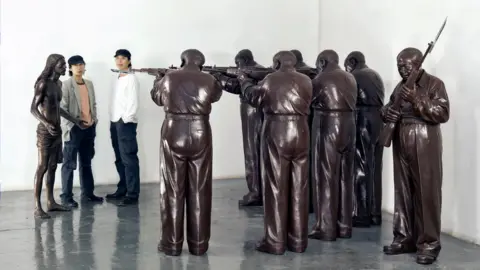
The artwork that caught the attention of authorities features a bronze sculpture titled ‘Execution of Christ’, depicting a figure of Jesus surrounded by rifle-wielding figures resembling Mao Zedong. This piece, among others, has placed Gao Zhen at the forefront of a confrontation between artistic expression and state censorship.
Gao, now 69, has long utilized his art to critique the oppressive history and political landscape of China. His works often challenge the legacy of Mao Zedong, the founder of the People's Republic of China, reflecting a turbulent past that continues to influence contemporary society.
Since rising to prominence in the 1990s, Gao’s art has often attracted both acclaim and controversy. However, under Xi Jinping’s leadership, the political landscape for artists has severely contracted, with the introduction of laws that expand the scope of criminality in artistic endeavors.
His secretive trial for allegedly 'insulting revolutionary heroes' poses a grave concern for advocates of free expression. This case illustrates a chilling reality where even artworks created over a decade ago are punishable if their interpretation suddenly contradicts the prevailing political narrative.
As Gao’s family anxiously awaits his fate, the implications of his trial extend far beyond one individual. It embodies a critical moment for artistic expression under authoritarian control, raising questions about the future of free speech within China and the international community's response to these violations.
Experts and activists are voicing their concerns, calling for global attention to Gao's case, emphasizing that if his prosecution goes unchallenged, it could signal a precedent for the retroactive criminalization of art and dissent.