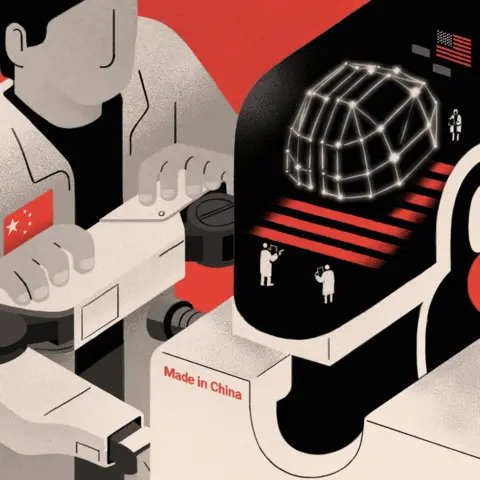
In the second half of the 20th Century, it was the race to develop nuclear arms that occupied some of the finest minds in the US and the Soviet Union. Now the US finds itself in a different kind of race with a different adversary: China. The aim is to dominate technology; specifically Artificial Intelligence (AI).
It's a fight taking place in research labs, on university campuses, and in the offices of cutting-edge start-ups - watched over by leaders of some of the world's richest companies, and at the highest levels of government. It costs trillions of US dollars.
Each side has its strengths - something Nick Wright, who works on cognitive neuroscience at University College London (UCL), sums up as the battle between brains and bodies. The US has traditionally led on so-called AI brains: the world of chatbots, microchips, and large language models (LLMs). China has superior AI bodies: robots, particularly humanoid robots that look eerily like people.
Now, with both sides anxious not to let their rival dominate, those advantages might not remain forever - and the race may transform further in the coming years.
Regarding LLM dominance, the launch of OpenAI's ChatGPT on November 30, 2022, shook the tech world. The model interacted conversationally and gained remarkable popularity, with more than 900 million users weekly. U.S. firms scramble to keep pace, pouring billions into similar technologies, recognizing the immense commercial potential.
However, the strategic dimension is pivotal; America holds a competitive edge not merely through innovative algorithms but also through ownership of high-end microchips, primarily designed by Nvidia. The U.S. employs stringent export controls to prevent China from accessing critical technologies, a policy sharpened in 2022, amid rising tensions.
Conversely, with developments like the launch of China’s DeepSeek AI chatbot, China demonstrates its capability to produce competitive models by leveraging a more open-source collaborative environment, starkly contrasting the more proprietary U.S. approach.
Simultaneously, China leads in robot technology, reinforced by substantial government investment and a robust manufacturing ecosystem. The sheer volume of robots employed in China surpasses those in the rest of the world combined.
In the evolving landscape, competition for AI may no longer be a clear dichotomy; the definitions of success and dominance are shifting. The ultimate victor will not solely be determined by isolated technological advancements but by the ability to integrate these innovations effectively into their economies and set global standards.
As both nations continue to shape their AI trajectories, the outcome of this race will significantly influence global power dynamics and technological governance for decades to come.
It's a fight taking place in research labs, on university campuses, and in the offices of cutting-edge start-ups - watched over by leaders of some of the world's richest companies, and at the highest levels of government. It costs trillions of US dollars.
Each side has its strengths - something Nick Wright, who works on cognitive neuroscience at University College London (UCL), sums up as the battle between brains and bodies. The US has traditionally led on so-called AI brains: the world of chatbots, microchips, and large language models (LLMs). China has superior AI bodies: robots, particularly humanoid robots that look eerily like people.
Now, with both sides anxious not to let their rival dominate, those advantages might not remain forever - and the race may transform further in the coming years.
Regarding LLM dominance, the launch of OpenAI's ChatGPT on November 30, 2022, shook the tech world. The model interacted conversationally and gained remarkable popularity, with more than 900 million users weekly. U.S. firms scramble to keep pace, pouring billions into similar technologies, recognizing the immense commercial potential.
However, the strategic dimension is pivotal; America holds a competitive edge not merely through innovative algorithms but also through ownership of high-end microchips, primarily designed by Nvidia. The U.S. employs stringent export controls to prevent China from accessing critical technologies, a policy sharpened in 2022, amid rising tensions.
Conversely, with developments like the launch of China’s DeepSeek AI chatbot, China demonstrates its capability to produce competitive models by leveraging a more open-source collaborative environment, starkly contrasting the more proprietary U.S. approach.
Simultaneously, China leads in robot technology, reinforced by substantial government investment and a robust manufacturing ecosystem. The sheer volume of robots employed in China surpasses those in the rest of the world combined.
In the evolving landscape, competition for AI may no longer be a clear dichotomy; the definitions of success and dominance are shifting. The ultimate victor will not solely be determined by isolated technological advancements but by the ability to integrate these innovations effectively into their economies and set global standards.
As both nations continue to shape their AI trajectories, the outcome of this race will significantly influence global power dynamics and technological governance for decades to come.