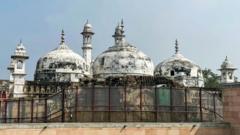
India is currently facing critical scrutiny over its Places of Worship (Special Provisions) Act, 1991, a law aimed at protecting the religious character of places of worship as they existed when India gained independence in 1947. The Supreme Court is deliberating on several petitions challenging this long-standing law, which prevents modifications to religious sites and prohibits courts from handling disputes about their status, barring the famous Babri Masjid case.
The Babri Masjid, which was demolished by Hindu nationalists in 1992, has long been a flashpoint for religious tensions in the country. A court ruling in 2019 allowed Hindus to construct a temple on the site, igniting further disputes regarding India's delicate religious landscape. As the Supreme Court examines petitions—including one from a member of the ruling Bharatiya Janata Party (BJP)—concerns have been raised that modifying this law would infringe upon religious freedoms and the principles of secularism enshrined in the Indian Constitution.
Supporters of the Act, including minority groups and opposition politicians, argue it is crucial for protecting religious minorities' places of worship, warning that any change could incite a wave of similar disputes over numerous mosques, which some Hindu groups claim were built atop destroyed temples. On Thursday, the Supreme Court temporarily prohibited courts from registering new petitions concerning the ownership or surveying of religious locations until a definitive ruling is issued in February.
The historical context of the law highlights its introduction amid rising religious strife and violence during the expansion of the campaign to construct a temple at the Babri Masjid site, which saw hundreds of deaths. The then-Congress government sought to curb these tensions by ensuring the preservation of religious sites. However, critics, including key figures from secular circles, argue that the BJP, while in opposition, fiercely opposed the law, viewing it as a compromise with minority groups.
Similar disputes continue to unfold, such as a recent court admission of a petition claiming a Hindu temple existed beneath the Ajmer Sharif shrine. Last month, violence erupted during a survey ordered by a local court of a 16th-century mosque in Uttar Pradesh, escalating communal tensions that have persisted in recent months over the Gyanvapi mosque as well.
The outcome of the Supreme Court's review, along with ongoing court decisions about surveying contested sites, remains crucial for India's religious fabric, raising fears of potential unrest as both Hindu and Muslim groups stake claims over profoundly historical and contentious religious grounds.