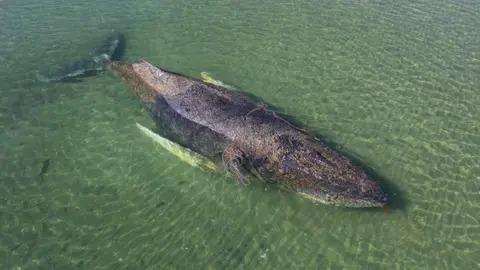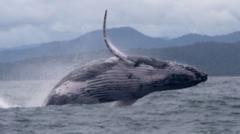
In a breathtaking display of endurance, a humpback whale has embarked on one of the longest migrations ever documented, alarming scientists who believe that this phenomenon may be linked to climate change. Initially spotted off Colombia's Pacific coast in 2017, the whale later resurfaced thousands of kilometers away in Zanzibar, traversing a staggering distance of at least 13,000 kilometers.
Experts theorize that shifts in climate may be depleting food sources, pushing whales to seek nourishment further afield, or that they are exploring new breeding territories due to population increases linked to global conservation efforts. Ekaterina Kalashnikova, of the Tanzania Cetaceans Program, called the migration “truly impressive and unusual” for humpback whales, known for their extensive migratory behaviors.
Dr. Kalashnikova noted that this particular whale's navigation across two distant breeding grounds likely constitutes the longest journey recorded for any humpback. These animals regularly migrate vast distances, traveling between tropical breeding habitats and colder feeding zones, but this male's remarkable trek has set a new precedent.
While the underlying reasons for this long-distance journey remain uncertain, potential factors include unprecedented environmental events and overall climate changes affecting food availability. The research, published in the journal Royal Society Open Science, draws upon a wealth of photographic data submitted by researchers and citizen scientists to the platform happywhale.com, which employs AI technology to track and analyze whale movements.
The journey's impressive scale reinforces concerns about the broader implications of climate change on marine ecosystems and whale behavior. As scientists continue to study these patterns, the compelling evidence serves as a reminder of the deep interconnectivity between climate health and wildlife migration strategies.
Experts theorize that shifts in climate may be depleting food sources, pushing whales to seek nourishment further afield, or that they are exploring new breeding territories due to population increases linked to global conservation efforts. Ekaterina Kalashnikova, of the Tanzania Cetaceans Program, called the migration “truly impressive and unusual” for humpback whales, known for their extensive migratory behaviors.
Dr. Kalashnikova noted that this particular whale's navigation across two distant breeding grounds likely constitutes the longest journey recorded for any humpback. These animals regularly migrate vast distances, traveling between tropical breeding habitats and colder feeding zones, but this male's remarkable trek has set a new precedent.
While the underlying reasons for this long-distance journey remain uncertain, potential factors include unprecedented environmental events and overall climate changes affecting food availability. The research, published in the journal Royal Society Open Science, draws upon a wealth of photographic data submitted by researchers and citizen scientists to the platform happywhale.com, which employs AI technology to track and analyze whale movements.
The journey's impressive scale reinforces concerns about the broader implications of climate change on marine ecosystems and whale behavior. As scientists continue to study these patterns, the compelling evidence serves as a reminder of the deep interconnectivity between climate health and wildlife migration strategies.