In brief
Over the past eight years, the Ngogo chimpanzees in Uganda have experienced a brutal split and are now involved in fierce territorial battles. The violence has resulted in 24 recorded killings, including 17 infants, highlighting a concerning decline in their social cohesion. Experts are examining the implications of this behavior as it relates to understanding the origins of human conflict.
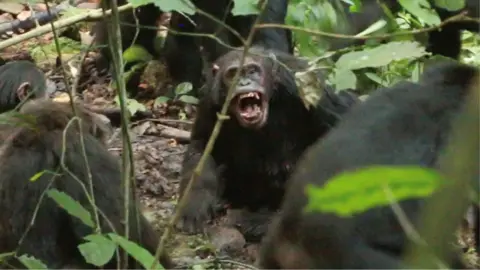
The world's largest known group of wild chimpanzees has split and been locked in a vicious 'civil war' for the last eight years, according to researchers. The once close-knit community of Ngogo chimpanzees at Uganda's Kibale National Park has recorded 24 killings, including 17 infants, since the conflict began in 2018. Lead author Aaron Sandel noted, 'These were chimps that would hold hands. Now they're trying to kill each other.' The findings, detailed in the journal Science, suggest the violence may provide insights into early human conflict. Sandel, an anthropologist from the University of Texas, highlighted the territorial behavior and hostile interactions typical of chimpanzees. Surprisingly, despite their natural aggression, the nearly 200 Ngogo chimpanzees had previously coexisted peacefully. Signs of division began in June 2015, escalating to a significant conflict in 2018 that led to organized attacks by the Western group on the Central chimpanzees. Researchers identified three primary catalysts for the conflict: mysterious deaths within the community that disrupted social networks, changes in leadership dynamics, and a devastating respiratory epidemic that weakened connections. The study's implications prompt a reevaluation of how human conflicts relate to natural behaviors observed in other primates, suggesting that relational dynamics may play a larger role than previously acknowledged.