NASA is releasing a steady stream of stunning pictures of the Moon and Earth taken by the astronauts on its Artemis II Moon mission. Attracting millions of likes on social media, the images show the two bodies from unusual angles in glorious high definition. There is no denying the drama: four astronauts are embarking on a mission that will take them further from Earth than any human has ventured since 1972. But is there unique scientific value in these images, or are these simply the equivalent of holiday photos?
NASA aims to engage the public by live-streaming the 10-day journey and providing regular video updates from the astronauts. The crew has shown so much excitement that the window of the Orion spacecraft became dirty, prompting instructions on how to clean it.
For the first time, digital cameras have ventured this far into space, with Orion housing 32 cameras and devices—15 mounted on the spacecraft and 17 handheld by the crew. The astronauts are using standard 10-year-old cameras like the Nikon D5, as well as GoPros and smartphones, documenting their journey on platforms such as Flickr.
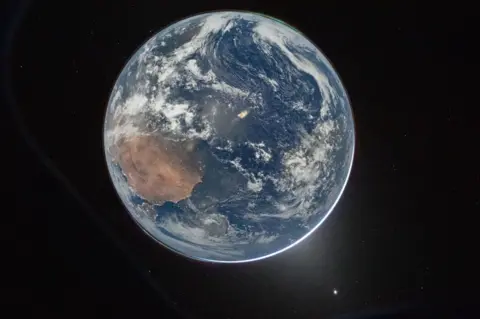
On April 2, 2026, Commander Reid Wiseman shared a poignant photograph titled "Hello, World," which captured two auroras as the Earth eclipsed the Sun. However, this image, while beautiful, offers little new scientific insight. NASA already has the Deep Space Climate Observatory, which regularly captures images from a million miles away, far surpassing the Artemis II mission’s perspectives.
As the mission progresses, NASA released another image of the Orientale basin on the Moon's far side, emphasizing its significance as the first time this area has been fully observed by human eyes. Experts suggest that while the images evoke beauty, their scientific value may be limited, as robotic missions have extensively mapped the lunar surface in recent years.
Critics, including Chris Lintott of the University of Oxford, argue the artistic value exceeds the scientific contributions of these photographs, likening the mission to a journey of exploration rather than a quest for scientific data. Given the competition in space exploration—especially from China—NASA's success with Artemis II is crucial not only for public engagement but also for establishing the United States' position in the ongoing space race.
As this crucial mission unfolds, we are invited to celebrate both the beauty of human exploration and the captivating photographs shared by the Artemis II crew.
NASA aims to engage the public by live-streaming the 10-day journey and providing regular video updates from the astronauts. The crew has shown so much excitement that the window of the Orion spacecraft became dirty, prompting instructions on how to clean it.
For the first time, digital cameras have ventured this far into space, with Orion housing 32 cameras and devices—15 mounted on the spacecraft and 17 handheld by the crew. The astronauts are using standard 10-year-old cameras like the Nikon D5, as well as GoPros and smartphones, documenting their journey on platforms such as Flickr.
On April 2, 2026, Commander Reid Wiseman shared a poignant photograph titled "Hello, World," which captured two auroras as the Earth eclipsed the Sun. However, this image, while beautiful, offers little new scientific insight. NASA already has the Deep Space Climate Observatory, which regularly captures images from a million miles away, far surpassing the Artemis II mission’s perspectives.
As the mission progresses, NASA released another image of the Orientale basin on the Moon's far side, emphasizing its significance as the first time this area has been fully observed by human eyes. Experts suggest that while the images evoke beauty, their scientific value may be limited, as robotic missions have extensively mapped the lunar surface in recent years.
Critics, including Chris Lintott of the University of Oxford, argue the artistic value exceeds the scientific contributions of these photographs, likening the mission to a journey of exploration rather than a quest for scientific data. Given the competition in space exploration—especially from China—NASA's success with Artemis II is crucial not only for public engagement but also for establishing the United States' position in the ongoing space race.
As this crucial mission unfolds, we are invited to celebrate both the beauty of human exploration and the captivating photographs shared by the Artemis II crew.