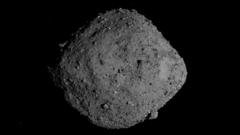
In a groundbreaking development, scientists have found the chemical building blocks of life within the dust of asteroid Bennu. The findings stem from samples retrieved by NASA’s Osiris Rex spacecraft, which successfully collected and returned approximately 120 grams of material from the 500-meter-wide asteroid to Earth in 2023. The analysis revealed a diverse array of organic compounds, including vital amino acids and nucleobases—crucial for protein and DNA structure, respectively.
Although these discoveries do not confirm that life ever existed on Bennu, they align with the hypothesis that asteroids have historically delivered the essential ingredients for life to planets such as Earth. Prof. Sara Russell from the Natural History Museum emphasizes the significance of this research, stating it sheds light on profound questions regarding the origins of life.
The study published in the journal Nature highlights that Bennu's dust is rich in nitrogen and carbon-based compounds, featuring 14 out of the 20 amino acids used to form proteins on Earth. It also includes the four nucleobases essential for DNA: adenine, guanine, cytosine, and thymine. Furthermore, researchers found minerals suggesting that water may have once existed on Bennu, with ammonia identified as a key player in biochemical reactions.
The analysis conveys an unprecedented richness of material that scientists had not encountered in previously studied meteorites, paving the way for an exciting future in planetary science. Dr. Ashley King from the Natural History Museum remarked on how the early Solar System was a chaotic environment filled with asteroids which likely bombarded planets, including Earth, thereby delivering vital elements necessary for the emergence of life.
As Earth stands alone in hosting life, researchers are now tasked with deciphering why life flourished here while other celestial bodies remained desolate. With ongoing studies planned on the samples from Bennu, scientists are eager to explore the implications for life in the wider Solar System, venturing into the prospects of discovering similar conditions elsewhere beyond Earth.
Although these discoveries do not confirm that life ever existed on Bennu, they align with the hypothesis that asteroids have historically delivered the essential ingredients for life to planets such as Earth. Prof. Sara Russell from the Natural History Museum emphasizes the significance of this research, stating it sheds light on profound questions regarding the origins of life.
The study published in the journal Nature highlights that Bennu's dust is rich in nitrogen and carbon-based compounds, featuring 14 out of the 20 amino acids used to form proteins on Earth. It also includes the four nucleobases essential for DNA: adenine, guanine, cytosine, and thymine. Furthermore, researchers found minerals suggesting that water may have once existed on Bennu, with ammonia identified as a key player in biochemical reactions.
The analysis conveys an unprecedented richness of material that scientists had not encountered in previously studied meteorites, paving the way for an exciting future in planetary science. Dr. Ashley King from the Natural History Museum remarked on how the early Solar System was a chaotic environment filled with asteroids which likely bombarded planets, including Earth, thereby delivering vital elements necessary for the emergence of life.
As Earth stands alone in hosting life, researchers are now tasked with deciphering why life flourished here while other celestial bodies remained desolate. With ongoing studies planned on the samples from Bennu, scientists are eager to explore the implications for life in the wider Solar System, venturing into the prospects of discovering similar conditions elsewhere beyond Earth.