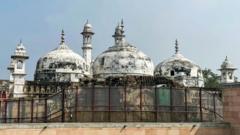
The ongoing debate over India's Places of Worship law, enacted in 1991, continues to be a contentious issue as the Supreme Court hears multiple petitions questioning its constitutionality. The law protects the character of religious places—be they temples, mosques, churches, or gurdwaras—established as of August 15, 1947, effectively preventing any changes or legal disputes regarding their status, with the notable exception of the Babri Masjid case.
The Babri Masjid, a 16th-century mosque, became a focal point in a prolonged dispute, culminating in its demolition by a Hindu mob in 1992. A 2019 court ruling resolved its contentious status, granting the site to Hindus for constructing a temple. This pivotal moment reignited national debates surrounding India's religious and secular identities, especially as Hindu groups have since initiated challenges against various mosques, claiming many were erected on the ruins of Hindu temples.
Recent petitions, including contributions from Prime Minister Narendra Modi's Bharatiya Janata Party (BJP), argue that the 1991 law violates religious freedoms and the principles of constitutional secularism. Meanwhile, detractors, including opposition leaders and Muslim organizations, vigorously defend the law, emphasizing its role in protecting minority religious sites in a predominantly Hindu nation. They caution that any weakening of the law could unleash a wave of similar legal disputes, potentially exacerbating religious tensions.
In a significant interim ruling last Thursday, the Supreme Court prohibited the registration of new cases related to the ownership of places of worship and barred any surveys aiming to redefine their character until further notice. The court's next hearing on this matter is scheduled for February.
The Places of Worship (Special Provisions) Act was enacted against a tumultuous backdrop, as the BJP spearheaded a movement to build a temple at the Babri Masjid site while the country grappled with sectarian strife following the partition of India in 1947. Then-home minister SB Chavan, who introduced the bill, voiced concerns about the rising intolerance fueled by certain factions pursuing narrow interests through the "forcible conversion" of places of worship.
Critics have drawn attention to the law’s renewed relevance, given the current disputes surrounding the Gyanvapi and Shahi Eidgah mosques in Varanasi and Mathura, respectively. Outside of these notable mosques, a recent petition was admitted by a court in Rajasthan, which alleges the existence of a temple beneath the revered Ajmer Sharif shrine. Such developments underscore persistent tensions—including a violent incident last month in Sambhal town, which led to multiple fatalities during a contested mosque survey.
As the Supreme Court's deliberation continues, the fate of numerous religious sites hangs in the balance, pivotal not only for individuals and groups involved but for the broader context of religious coexistence in India.
The Babri Masjid, a 16th-century mosque, became a focal point in a prolonged dispute, culminating in its demolition by a Hindu mob in 1992. A 2019 court ruling resolved its contentious status, granting the site to Hindus for constructing a temple. This pivotal moment reignited national debates surrounding India's religious and secular identities, especially as Hindu groups have since initiated challenges against various mosques, claiming many were erected on the ruins of Hindu temples.
Recent petitions, including contributions from Prime Minister Narendra Modi's Bharatiya Janata Party (BJP), argue that the 1991 law violates religious freedoms and the principles of constitutional secularism. Meanwhile, detractors, including opposition leaders and Muslim organizations, vigorously defend the law, emphasizing its role in protecting minority religious sites in a predominantly Hindu nation. They caution that any weakening of the law could unleash a wave of similar legal disputes, potentially exacerbating religious tensions.
In a significant interim ruling last Thursday, the Supreme Court prohibited the registration of new cases related to the ownership of places of worship and barred any surveys aiming to redefine their character until further notice. The court's next hearing on this matter is scheduled for February.
The Places of Worship (Special Provisions) Act was enacted against a tumultuous backdrop, as the BJP spearheaded a movement to build a temple at the Babri Masjid site while the country grappled with sectarian strife following the partition of India in 1947. Then-home minister SB Chavan, who introduced the bill, voiced concerns about the rising intolerance fueled by certain factions pursuing narrow interests through the "forcible conversion" of places of worship.
Critics have drawn attention to the law’s renewed relevance, given the current disputes surrounding the Gyanvapi and Shahi Eidgah mosques in Varanasi and Mathura, respectively. Outside of these notable mosques, a recent petition was admitted by a court in Rajasthan, which alleges the existence of a temple beneath the revered Ajmer Sharif shrine. Such developments underscore persistent tensions—including a violent incident last month in Sambhal town, which led to multiple fatalities during a contested mosque survey.
As the Supreme Court's deliberation continues, the fate of numerous religious sites hangs in the balance, pivotal not only for individuals and groups involved but for the broader context of religious coexistence in India.