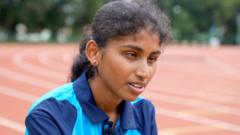
Rakshitha Raju, a 24-year-old blind athlete from a remote village in southern India, has risen to prominence in the world of para athletics, shattering the stereotypes that plagued her upbringing. Growing up, she faced constant ridicule from locals who dismissed her potential. “They would say: 'She is blind, she is a waste'," Rakshitha recalls.
Raised by her grandmother, who also has disabilities, Rakshitha found a kindred spirit. “Both of us understand each other’s challenges,” she explains. At the age of 13, encouragement from her sports teacher spurred her interest in athletics, despite her initial doubts about running without sight.
The teacher introduced the concept of a guide runner, who would assist her by running alongside her while holding a tether. This innovative approach allows visually impaired runners to participate in competitions under fair conditions despite varying levels of vision impairment.
Her journey took a significant turn when she met Rahul Balakrishna at the 2016 National Games. An experienced middle-distance runner himself, Rahul recognized the potential in Rakshitha and decided to take on the role of both coach and guide. Despite the lack of financial support for guide runners, he dedicated his resources and time to ensure Rakshitha received the training she needed.
Their partnership blossomed, and they eventually trained together for eight years. They achieved remarkable success, winning gold medals at the Asian Games in 2018 and 2023. Upon returning home, Rakshitha was met with a hero’s welcome, proudly reflecting on the transformation of those who once mocked her.
Rakshitha made history as the first blind Indian woman to qualify for the 1500m at the Paralympics, competing in 2024 in Paris alongside Rahul. Though they did not secure a medal, another visually impaired athlete, Simran Sharma, brought home the bronze in sprinting events, showcasing the potential of Indian female athletes with disabilities.
Simran's story also highlights the challenges faced by visually impaired athletes in finding suitable guide runners. After initially running alone, Simran partnered with Abhay Kumar, and despite early setbacks, they quickly achieved success, becoming the World Champion in the T12 category. Simran is now focused on the next Paralympics, determined to improve upon her performance.
Both Rakshitha and Simran are now sponsored, allowing them to invest in their training and support their guides. However, there is an ongoing call for greater support from the Paralympic Committee of India, primarily regarding financial remuneration and job opportunities for guide runners who play crucial roles in their successes.
Looking ahead, Rakshitha aims for medal success with Rahul by her side, inspiring other young athletes from her background. The journey of these remarkable women reflects their resilience and commitment to achieving greatness, paving the way for future generations in Indian sports.
As the Indian sports community gears up for the fifth edition of the BBC Indian Sportswoman Of The Year Award, it remains vital to celebrate the incredible achievements of athletes like Rakshitha and Simran, who continue to challenge societal norms and showcase the strength of the human spirit.