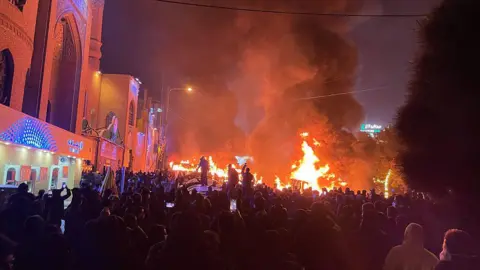
For Mojdeh and her husband, the question of U.S. intervention in Iran is personal. In early January, they traveled from their home in Washington, DC, to Tehran to visit family, expecting a short, routine trip. Instead, protests spread, flights were cancelled, and they found themselves stranded in a city that no longer felt predictable.
Life was on pause, Mojdeh said, especially at night when the internet and phone networks went dark. Initially planning to stay uninvolved, the couple felt compelled to engage as protesters filled the streets and security forces struggled to maintain order.
Protests across Iran erupted just before the new year, driven by widespread dissatisfaction with economic hardship and a declining currency. These quickly escalated into calls for an end to the Islamic Republic, leading to a violent crackdown by security forces.
U.S. President Donald Trump has expressed support for the Iranian protesters, stating that the regime seems eager to negotiate. However, perceptions vary significantly among those in Iran and the Iranian diaspora regarding U.S. involvement.
Shirin, an Iranian-American in California, argues for intervention as essential to demonstrate global commitment to stopping violence in Iran. Conversely, others, like Roozbeh Farahanipour, express concerns that U.S. intervention could exacerbate harm to their loved ones.
Yet there are those, like Ali and Hemad Nazari, advocates for intervention express it as a necessary evil, supporting targeted strikes to weaken the oppressive regime from within. They cite increasing desperation among Iranians at home, who feel without international action, their plight may continue unmitigated.
Overall, with arrest estimates reaching over 40,000 and ongoing concern for basic human rights in Iran, the international community is confronted with pressing questions surrounding the efficacy and morality of potential U.S. intervention.
Life was on pause, Mojdeh said, especially at night when the internet and phone networks went dark. Initially planning to stay uninvolved, the couple felt compelled to engage as protesters filled the streets and security forces struggled to maintain order.
Protests across Iran erupted just before the new year, driven by widespread dissatisfaction with economic hardship and a declining currency. These quickly escalated into calls for an end to the Islamic Republic, leading to a violent crackdown by security forces.
U.S. President Donald Trump has expressed support for the Iranian protesters, stating that the regime seems eager to negotiate. However, perceptions vary significantly among those in Iran and the Iranian diaspora regarding U.S. involvement.
Shirin, an Iranian-American in California, argues for intervention as essential to demonstrate global commitment to stopping violence in Iran. Conversely, others, like Roozbeh Farahanipour, express concerns that U.S. intervention could exacerbate harm to their loved ones.
Yet there are those, like Ali and Hemad Nazari, advocates for intervention express it as a necessary evil, supporting targeted strikes to weaken the oppressive regime from within. They cite increasing desperation among Iranians at home, who feel without international action, their plight may continue unmitigated.
Overall, with arrest estimates reaching over 40,000 and ongoing concern for basic human rights in Iran, the international community is confronted with pressing questions surrounding the efficacy and morality of potential U.S. intervention.