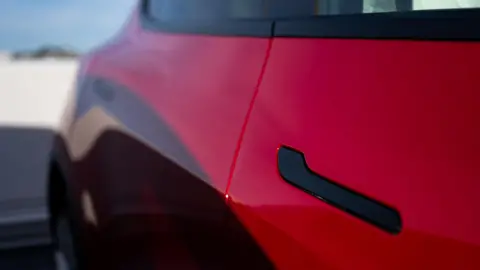
China has banned hidden door handles on electric vehicles (EVs), making it the first country to stop the use of the controversial designs that were made popular by multi-billionaire Elon Musk's Tesla. This comes as EVs are facing scrutiny from safety watchdogs around the world after a number of deadly incidents, including two fatal crashes in China involving Xiaomi EVs in which power failures were suspected to have prevented doors from being opened. Under the new regulations, cars will only be allowed to be sold if they have a mechanical release both on the inside and outside of their doors, according to state media.
The new rules are set to take effect on January 1, 2027. The Ministry of Industry and Information Technology has stated that the outside of every passenger door, except for the boot, must feature a recessed space measuring no smaller than 6cm by 2cm by 2.5cm to allow access to the handle. Additionally, signs at least 1cm by 0.7cm must be present inside the car to indicate how to open the door.
Existing models already approved by authorities and in the final stages before entering the Chinese market will have an extension of two years to update their designs. Hidden handles are extensively used in China's new energy vehicle (NEV) market, which includes both EVs and hybrids, featuring in approximately 60% of the top 100 best-selling NEVs, according to data cited by government-controlled newspaper China Daily.
Although this regulation will only apply to models sold in China, the country's substantial influence in the global car industry suggests the move could have far-reaching repercussions internationally. Tesla's door handles are also currently under investigation by US safety regulators, with authorities in Europe considering similar regulations. Concerns have arisen after reports of Tesla's handles suddenly stopping functioning, leading to critical situations where children became trapped inside vehicles. The US National Highway Traffic Safety Administration (NHTSA) even opened a probe in response to complaints about these handles in Tesla's 2021 Model Y, prompting emergency measures from some owners who resorted to breaking windows. This regulatory shift signals a broader trend towards prioritizing safety in the rapidly evolving electric vehicle market.
The new rules are set to take effect on January 1, 2027. The Ministry of Industry and Information Technology has stated that the outside of every passenger door, except for the boot, must feature a recessed space measuring no smaller than 6cm by 2cm by 2.5cm to allow access to the handle. Additionally, signs at least 1cm by 0.7cm must be present inside the car to indicate how to open the door.
Existing models already approved by authorities and in the final stages before entering the Chinese market will have an extension of two years to update their designs. Hidden handles are extensively used in China's new energy vehicle (NEV) market, which includes both EVs and hybrids, featuring in approximately 60% of the top 100 best-selling NEVs, according to data cited by government-controlled newspaper China Daily.
Although this regulation will only apply to models sold in China, the country's substantial influence in the global car industry suggests the move could have far-reaching repercussions internationally. Tesla's door handles are also currently under investigation by US safety regulators, with authorities in Europe considering similar regulations. Concerns have arisen after reports of Tesla's handles suddenly stopping functioning, leading to critical situations where children became trapped inside vehicles. The US National Highway Traffic Safety Administration (NHTSA) even opened a probe in response to complaints about these handles in Tesla's 2021 Model Y, prompting emergency measures from some owners who resorted to breaking windows. This regulatory shift signals a broader trend towards prioritizing safety in the rapidly evolving electric vehicle market.