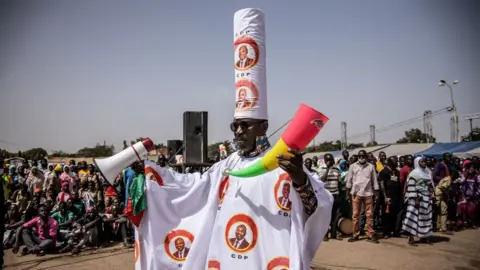
Burkina Faso's junta has announced a ban on all political parties, whose activities have been suspended since the military seized power in 2022. Junta leader Captain Ibrahim Traoré has been criticised for suppressing dissent and the move will be seen as the latest move to tighten control. According to Burkina Faso's Interior Minister Emile Zerbo, the ban is part of plans to 'rebuild the state' after what he said were 'numerous abuses' in the country's multiparty system. Zerbo claimed the system had been 'promoting division among citizens and weakening the social fabric'. Previously, parties were banned from public gatherings, but the new decree now stops them from operating altogether. All assets of the dissolved parties will be transferred to the state, and a draft law will be sent to the Transitional Legislative Assembly 'as soon as possible'. The country had more than 100 registered political parties before the coup, with 15 represented in parliament after the 2020 general election. A member of a civil society group expressed dismay, stating, 'This will not help the country move forward. We're not happy with this.' Critics argue that the regime is portraying democracy as detrimental to Burkina Faso, while some public support has emerged for the junta's decision, indicating division in public opinion. The junta's recent actions follow its takeover, which displaced the prior leader after only nine months in power, and it has further pledged to restore civilian governance by July 2024, though it has also hinted at extending rule for an additional five years.
Burkina Faso Junta Bans All Political Parties Amidst Criticism
Burkina Faso Junta Bans All Political Parties Amidst Criticism
Burkina Faso's military government has declared a complete ban on all political parties, intensifying its grip on power since the coup in 2022. This decision has sparked debate over the future of democracy in the nation.
The junta in Burkina Faso, led by Captain Ibrahim Traoré, has announced a ban on all political parties, asserting that the prior multiparty system led to divisions and abuses. While some support the move, critics warn that it undermines democracy and could pave the way for further instability. The Interior Minister has cited plans to 'rebuild the state' as justification for this drastic measure.