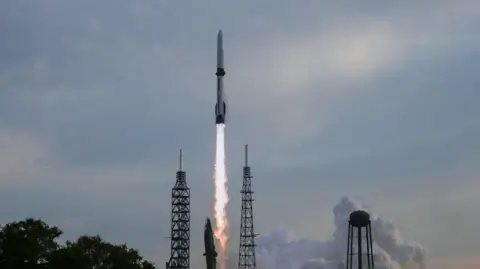
Elon Musk's SpaceX has applied to launch one million satellites into Earth's orbit to power artificial intelligence (AI). The application claims that 'orbital data centres' are the most cost and energy-efficient way to meet the growing demand for AI computing power. Traditionally, such centres are large warehouses filled with powerful computers that process and store data, but Musk's aerospace firm asserts that the processing needs due to the increasing utilization of AI have already outpaced 'terrestrial capabilities'. These satellites would integrate with SpaceX's Starlink network, which provides high-speed internet through thousands of small satellites, and has been criticized for contributing to congestion in space — a claim that Musk denies. According to the application, the new network could consist of up to one million solar-powered satellites. SpaceX asserts that this system would deliver the computer capacity needed to accommodate 'billions of users globally.' The initiative is considered the first step toward becoming a Kardashev II-level civilization, capable of harnessing the Sun's full power. Musk commented on X, stating, 'The satellites will actually be so far apart that it will be hard to see from one to another. Space is so vast as to be beyond comprehension.' The satellites would be situated in low-Earth orbit, operating at altitudes ranging from 500 to 2,000 km (310 to 1,242 miles). SpaceX argues that 'orbital data centres'—a concept also being examined by other companies—would present a greener alternative to conventional centres, which require substantial power and water for cooling. However, experts have pointed out that launching hardware into orbit continues to be costly, with infrastructure needs for protection, cooling, and powering being complex, while the increasing quantity of space debris poses risks to the hardware. Concerns have also been raised regarding the likelihood of crashes between objects in the ever-crowded low-orbit space, which could lead to damages or hazards associated with materials falling back to Earth. Additionally, astronomers reported in 2024 that radio waves from the Starlink network were 'blinding' their telescopes and impeding their research. Musk has dismissed suggestions that his satellites are crowding out competitors.
SpaceX Seeks Approval to Launch One Million Satellites for AI Processing
SpaceX Seeks Approval to Launch One Million Satellites for AI Processing
Elon Musk's SpaceX has filed a proposal with the FCC to deploy one million satellites into orbit, aiming to support the rising demands of artificial intelligence (AI) computing power.
SpaceX's ambitious proposal aims to launch one million satellites into Earth's orbit to create 'orbital data centres' that are more efficient than traditional, land-based data processing facilities. This initiative is viewed as a response to the growing demand for AI computing capabilities. The satellites would enhance the existing Starlink network and operate at low-Earth orbit altitudes.