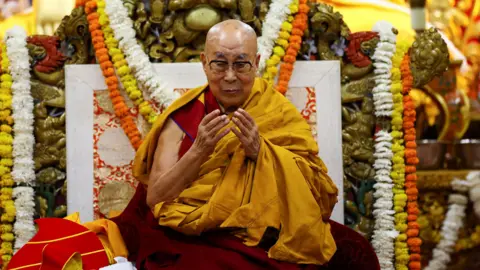
China has reacted angrily to an unlikely winner at the Grammys - the Dalai Lama - saying it opposes art awards being used for 'anti-China political manipulation'. The Buddhist spiritual leader was recognised in the audiobook category for 'Meditations: The Reflections of His Holiness the Dalai Lama'. The Dalai Lama expressed his acceptance of the award with 'gratitude and humility'. At 90 years old, he has lived in exile from his Tibetan homeland since 1959 and is condemned as a rebel and separatist by Beijing.
China's foreign ministry spokesman Lin Jian stated at a press conference: 'We firmly oppose relevant parties using art awards as a tool for anti-China political manipulation, and this position is consistent and clear.' The spiritual leader, who resides in Dharamshala, India, fled China after Chinese troops put down an uprising and has campaigned for more autonomy for Tibet, a region Beijing claims as an integral part of China.
In a message on social media, the Dalai Lama, also a Nobel peace laureate, noted: 'I receive this recognition with gratitude and humility... I don't see it as something personal, but as a recognition of our shared universal responsibility.' The award was collected on his behalf by musician Rufus Wainwright, who collaborated on the audiobook.
Last year, the Dalai Lama confirmed plans to name a successor, inciting further tension with China. Following Tibetan Buddhist tradition, his reincarnation occurs in 'the free world', meaning outside of China, which Beijing dismissed as unauthorized. Chinese officials insist that any succession must adhere to Chinese laws and be approved by the Beijing government, fueling fears that China may attempt to impose its authority over Tibetan spiritual leadership.
China's foreign ministry spokesman Lin Jian stated at a press conference: 'We firmly oppose relevant parties using art awards as a tool for anti-China political manipulation, and this position is consistent and clear.' The spiritual leader, who resides in Dharamshala, India, fled China after Chinese troops put down an uprising and has campaigned for more autonomy for Tibet, a region Beijing claims as an integral part of China.
In a message on social media, the Dalai Lama, also a Nobel peace laureate, noted: 'I receive this recognition with gratitude and humility... I don't see it as something personal, but as a recognition of our shared universal responsibility.' The award was collected on his behalf by musician Rufus Wainwright, who collaborated on the audiobook.
Last year, the Dalai Lama confirmed plans to name a successor, inciting further tension with China. Following Tibetan Buddhist tradition, his reincarnation occurs in 'the free world', meaning outside of China, which Beijing dismissed as unauthorized. Chinese officials insist that any succession must adhere to Chinese laws and be approved by the Beijing government, fueling fears that China may attempt to impose its authority over Tibetan spiritual leadership.