In brief
At a recent fashion show in Ghana, Abena Christine Jon'el made waves walking the runway with a colorful kente-wrapped prosthetic leg. Battling cancer from a young age, she uses her platform to challenge stereotypes about disability and promote visibility. Her journey from a cancer survivor to an advocate embodies a story of reclamation and cultural pride, asserting that people with disabilities deserve to be seen as ambitious and talented individuals.
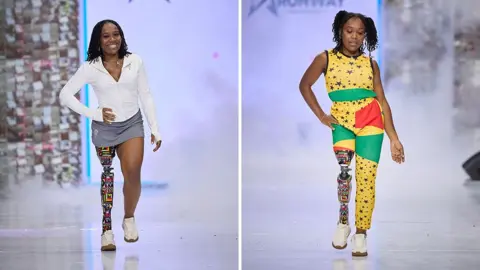
It was hard to miss 33-year-old model and writer Abena Christine Jon'el's appearance at a recent major fashion show in Ghana. Walking the runway with her prosthetic leg wrapped in a colourful African print her appearance made a big impact.
The Ghanaian-American was hoping to make a statement about the visibility of people with disabilities, building on years of work in the US and here in Ghana of speaking out on the issue.
At two years old, Abena's life became defined by a challenge most adults would struggle to face. A large tumour had appeared on her right calf, the first sign of a rare, aggressive soft-tissue cancer, rhabdomyosarcoma. Doctors presented her mother with a difficult choice: radiation, which could have left her dependent on a wheelchair, or amputation. Her mother chose the latter.
It was the best decision she could have made, Abena says today without hesitation, speaking to the BBC. She now lives in Ghana, but she grew up in Chicago in the US.
Even before she understood what cancer was, her early life was shaped by treatment and recovery. Movement became a way of measuring survival and rebuilding confidence. In a way, it was taking ownership of a body that had been through so much.
But when she speaks about her younger years, it is not the cliché story of the inspirational disabled child; she rejects that stereotype entirely. People imagine disabled kids as straight-A students who are sweet, quiet and perfect, she says, recounting her more vibrant personality.
Abena's advocacy found a new stage, literally, at the 15th edition of Rhythms on the Runway, one of Africa's most celebrated annual fashion shows. She wanted to open the door to a different kind of representation, to force a conversation about how people with disabilities are perceived in Ghana.
Her prosthetic leg wrapped in kente is a declaration of her love for Ghana. Living with a disability in Ghana has brought a new mission into her life, centered around visibility and representation of disabled people. In Ghana, disabled people have not been widely showcased in a positive light, she notes.
Through her work, Abena aims to change perceptions, showcasing disabled individuals as ambitious, stylish, and capable, rather than simply as figures of struggle. Disability is not a limitation. Lack of support, lack of accessibility, that is what disables you, she affirms.
Abena's journey from a two-year-old cancer patient to a woman reshaping how Ghana sees disability is not just a story of survival; it's a powerful narrative of reclamation, identity, and a call for inclusion that resonates well beyond the runway.