In brief
A drone strike on the Chernobyl protective shelter has been confirmed by Ukrainian President Volodymyr Zelensky, who reported the incident resulted in a fire, now extinguished. Despite the International Atomic Energy Agency (IAEA) stating that radiation levels are stable, concerns about possible radioactive leaks persist. Russia denies involvement, stating it does not target Ukrainian nuclear infrastructure. The IAEA has heightened its alert status while experts assess the damage to the shelter, a critical structure designed to contain radioactive materials from the 1986 catastrophe. As military activities intensify near other nuclear facilities in Ukraine, calls for international cooperation on nuclear safety are growing louder.
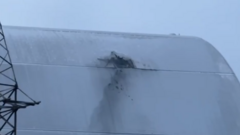
The article text:A Russian drone has struck the protective shelter over Chernobyl's damaged nuclear reactor, according to Ukrainian President Volodymyr Zelensky. This overnight strike at the site of the world’s worst nuclear disaster has raised fears of radioactive leaks following a fire, which has since been brought under control. The UN's nuclear watchdog (IAEA) initially reported stable radiation levels inside and outside Chernobyl, but the plant's chief engineer, Oleksandr Titarchuk, warned that the potential for radioactive substance leaks now exists.Russia has firmly denied these claims, asserting that its military does not target Ukrainian nuclear infrastructure and that such allegations are unfounded. The IAEA stated that emergency services responded quickly to an explosion at the site, and no casualties were reported. However, they remain on “high alert” due to the incident, with IAEA Director General Rafael Grossi emphasizing that there is “no room for complacency.” Titarchuk reassured that the situation is “under control.”The catastrophic explosion at Chernobyl in 1986 released a significant amount of radioactive material into the environment, leading to enhanced cancer rates among surrounding populations. The radiation shield, which was constructed for $1.6 billion, is designed to prevent further leaks over the next century and is a massive structure measuring 275 meters wide and 108 meters tall. Footage shared by Zelensky showed visible damage to this critical shield.Hryhoriy Ishchenko, head of Chernobyl's exclusion zone agency, indicated that a direct impact just 15 meters away could have resulted in a serious radiation incident. Experts expressed deep concern over the strike as it was deemed an "incredibly reckless" act against a fragile nuclear facility. Prof. Jim Smith from the University of Portsmouth highlighted that while the strike is alarming, the thick concrete sarcophagus built to cover radioactive materials beneath the damaged shield still mitigates immediate risks.The strike seemed to impact a crane maintenance system used for the reactor's deconstruction, as described by Simon Evans from the European Bank for Reconstruction and Development. He indicated that significant damage has been observed, stressing that an in-depth assessment is necessary to determine the financial implications. Evans also lamented the disregard for international cooperation on nuclear safety amid ongoing military tensions.Highlighting the severity of the incident, Zelensky asserted it demonstrated that Russian President Vladimir Putin is “definitely not preparing for negotiations,” particularly after claims from U.S. President Donald Trump that Putin agreed to initiate peace talks. As military operations around the Zaporizhzhia Nuclear Power Plant escalate, concerns regarding nuclear safety persist, with experts expressing greater alarm about this facility compared to Chernobyl.The legacy of the Chernobyl disaster continues to evoke fear and ongoing disputes over casualty counts still linger today. The suggestive impact of an incident at such a vulnerable site has reignited debates over nuclear security and the global response to military actions around active nuclear facilities.