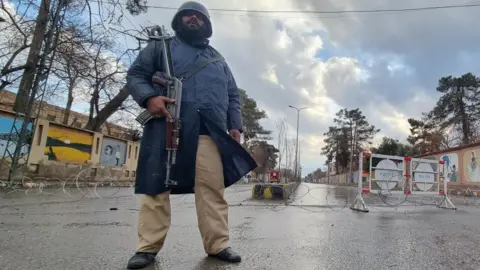
Pakistan's military says it has killed at least 92 militants blamed for deadly coordinated attacks in the south-western Balochistan province on Saturday. The military stated that 15 security service personnel and 18 civilians were also killed during the violence, accusing India of supporting the militants—a claim vigorously denied by Delhi.
The Balochistan Liberation Army (BLA) rebel group has previously claimed responsibility for these attacks, alleging the loss of numerous soldiers on their side as well.
Reports indicate that this recent violence marks one of the deadliest days in Balochistan's longstanding struggle with an ethnic insurgency. In a statement issued late Saturday, Pakistan's military pointed fingers at the attackers for executing multiple strikes targeting civilians in and around the provincial capital, Quetta.
In response, the military launched extensive clearance operations throughout the province, claiming to have effectively thwarted the insurgents' plans. As a precautionary measure during the crackdown, significant administrative sites in Quetta were reportedly sealed off, mobile communications were disrupted, and train services were put on hold.
Prime Minister Shehbaz Sharif expressed his support for the military's actions, committing to continue the fight against terrorism until complete eradication is achieved. Earlier Saturday, militants armed with grenades and firearms targeted various police and paramilitary facilities across 12 cities in the province, alongside attacks on government installations and prisons.
The BLA asserts that the federal government exploits the region’s rich mineral resources without distributing benefits to local communities, citing longstanding grievances against Islamabad. Local activists have also accused Pakistani forces of practicing enforced disappearances, a claim that the government has denied.
Balochistan has seen resistance against the state dating back to 1948, following Pakistan's independence from British rule. Sharing borders with Iran and Taliban-led Afghanistan, the region is also noted for its extensive coastline along the Arabian Sea, marking its historical and strategic importance.
Balochistan, the largest province in Pakistan by area, covers approximately 44% of the country's land but houses only about 5% of its population. The province is rich in resources, including gas and various minerals.
The Balochistan Liberation Army (BLA) rebel group has previously claimed responsibility for these attacks, alleging the loss of numerous soldiers on their side as well.
Reports indicate that this recent violence marks one of the deadliest days in Balochistan's longstanding struggle with an ethnic insurgency. In a statement issued late Saturday, Pakistan's military pointed fingers at the attackers for executing multiple strikes targeting civilians in and around the provincial capital, Quetta.
In response, the military launched extensive clearance operations throughout the province, claiming to have effectively thwarted the insurgents' plans. As a precautionary measure during the crackdown, significant administrative sites in Quetta were reportedly sealed off, mobile communications were disrupted, and train services were put on hold.
Prime Minister Shehbaz Sharif expressed his support for the military's actions, committing to continue the fight against terrorism until complete eradication is achieved. Earlier Saturday, militants armed with grenades and firearms targeted various police and paramilitary facilities across 12 cities in the province, alongside attacks on government installations and prisons.
The BLA asserts that the federal government exploits the region’s rich mineral resources without distributing benefits to local communities, citing longstanding grievances against Islamabad. Local activists have also accused Pakistani forces of practicing enforced disappearances, a claim that the government has denied.
Balochistan has seen resistance against the state dating back to 1948, following Pakistan's independence from British rule. Sharing borders with Iran and Taliban-led Afghanistan, the region is also noted for its extensive coastline along the Arabian Sea, marking its historical and strategic importance.
Balochistan, the largest province in Pakistan by area, covers approximately 44% of the country's land but houses only about 5% of its population. The province is rich in resources, including gas and various minerals.