In brief
The EU and India have announced a major trade deal after nearly two decades of discussions, termed the 'mother of all deals' by European Commission President Ursula von der Leyen. The agreement facilitates the free exchange of goods, major tariff cuts on exports and imports, and further joint security partnerships. This historic pact is seen as a strategic move in response to geopolitical pressures, particularly from the US.
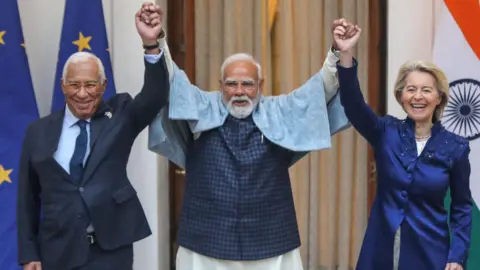
In a significant move to strengthen economic ties, the European Union (EU) and India have announced a landmark trade agreement following nearly two decades of intermittent negotiations. European Commission President Ursula von der Leyen hailed the pact as the 'mother of all deals' during a press briefing in Delhi, shortly after Indian Prime Minister Narendra Modi described it as 'historic'.The newly established deal aims to culminate in free trade across a multitude of goods and services between the EU's 27 member states and India, which has a combined population nearing two billion and represents nearly 25% of global GDP.Prominent aspects of the agreement include major tariff reductions for various goods, alongside a commitment to establish a joint security partnership. Specific details reveal that the EU will abolish tariffs on substantial exports including chemicals, machinery, and electrical equipment, while India plans to lower its hefty tariffs on European automobiles from a current high of 110% to just 10% under a quota arrangement.This trade agreement also encompasses provisions for India’s key exports such as textiles, leather, and various agricultural products, significantly easing access to EU markets.As the two economies navigate global pressures—most notably from the United States—their leaders have emphasized this partnership as a mutually beneficial strategy that underscores a commitment to cooperative economic solutions over punitive tariffs. Discussion around workers' mobility has also been initiated as part of the agreement, aimed at easing travel for professionals between India and the EU.Modi remarked that this agreement marks a pivotal enhancement for India's farmers and small businesses. Already challenged by the US's imposed tariffs, this collaboration with the EU is expected to augment India's export capabilities in labor-intensive sectors like textiles and seafood, while also preparing to meet the compliance standards set by the EU.With ongoing negotiations to expand cooperation in security and defense, both sides are positioning this trade deal not merely as a financial transaction but as a foundational element in forging deeper geopolitical alliances in a rapidly evolving global landscape.