In brief
The recent conflict involving Iran has intensified discussions about who is in charge of decision-making in the country. Mojtaba Khamenei, having succeeded his father Ali Khamenei, formally holds the title of supreme leader. However, his public absence and reported injuries have led to a perceived fragmentation of power, raising concerns about the effectiveness of Iran's leadership during a critical military crisis. Diplomatic efforts appear weak as military influences grow, complicating the nation's strategic coherence.
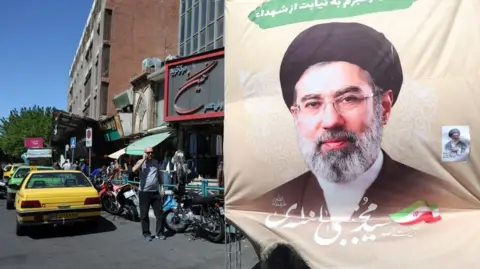
The question hanging over Tehran since the opening strikes of Iran's current war with the US and Israel is simple: Who is in charge? Formally, the answer is clear. Mojtaba Khamenei has assumed the role of supreme leader following the killing of his father, Ali Khamenei, on the first day of the war on 28 February. In the Islamic Republic's system, that position is meant to be decisive. The leader has the final word on almost anything important: war, peace, and the state's strategic direction. But in practice, the picture is far murkier.Donald Trump has described Iran's leadership as fractured and suggested the US is waiting for Tehran to produce a unified proposal. Unity was certainly on the minds of Iran's leaders when they distributed a message to Iranians on their mobile phones on Thursday night saying there was no such thing as a hardliner or moderate in Iran - there was just one nation, one course.Mojtaba Khamenei has not been seen in public since taking power. Beyond a handful of written statements, there is little direct evidence of his day-to-day control. Iranian officials have acknowledged that he was injured in the initial strikes but have offered few details. Reports suggest he may have suffered several injuries that have made it difficult for him to speak.This absence matters. In Iran's political system, authority is not just institutional - it is also performative. Khamenei's late father signalled intent through speeches and visible arbitration between factions. That signalling function is now largely missing, leading to a vacuum of interpretation.Diplomatic channels remain open, but their effectiveness is undermined by a lack of clear leadership. Foreign Minister Abbas Araghchi's role appears operational rather than directive, and the diplomatic track seems dictated by military actions rather than leading them.As power shifts more towards military influence, particularly with the IRGC making critical strategic decisions, the coherence of Iran's decision-making process comes into question. Ghalibaf, the speaker of parliament and a former Revolutionary Guard commander, has emerged as a visible figure in negotiations, but the precarious balance of power leaves the future direction of Iran uncertain.