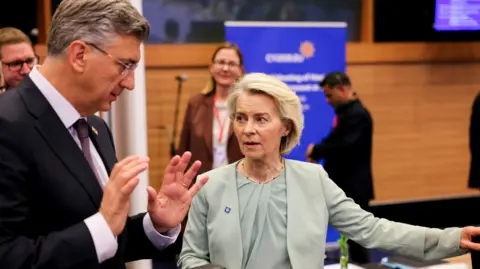
It's become a joke - through gritted teeth - these days in EU circles, that whenever leaders meet, as they did these last two days in Cyprus - expecting to discuss practicalities, such as the new EU budget - they get railroaded by yet another crisis.
There is the ongoing energy crisis provoked by the US-Israel war on Iran, Russia's aggression in neighbouring Ukraine, now in its fourth year. And this Friday morning, souring relations between Europe and the United States, along with a potentially devastating defence impact, reared its Medusa-like head. Again.
No worries, Spain's determined-to-appear calm prime minister, Pedro Sanchez, said to waiting journalists as he arrived at the leaders' summit. We are fulfilling our obligations toward NATO.
What did he feel compelled to say he wasn't fretting about?
An email, originating from the US Pentagon and first reported by Reuters, had leaked, suggesting measures for the US to punish allies it believed had failed to support the US-Israel campaign against Iran. The email said the US could seek to suspend Spain from NATO over its stance.
There is actually no provision in the NATO treaties to expel a member country. And any action to bar Spain from filling key civilian or military roles in NATO, also alluded to in the email as possible punitive action, would have to be taken unanimously among all NATO members.
Fellow EU leaders, at the Cyprus summit, who are also in NATO, leaped to Spain's defence. Dutch Prime Minister Rob Jetten said he wanted to be crystal clear that Spain was and would remain a full NATO member. He said European countries were currently doing a great deal to strengthen NATO. That, he said, was also in America's interest.
A high-ranking German official said Spain is a member of NATO. And I see no reason why that should change.
While Italian premier Giorgia Meloni criticized the tensions between Washington and Madrid as not at all positive. The growing public opinion against Donald Trump in Italy has forced her to take a stance contrary to her earlier support.
The leaked Pentagon email also suggested a potential diplomatic fallout for the UK over its Falklands claims, demonstrating the far-reaching implications of US foreign policy tensions on NATO dynamics.
In light of recent events, NATO leaders have begun exploring EU treaty articles regarding mutual defence. With external threats like Russia's aggression strategizing against NATO nations, the alliance's unity is deemed crucial. The email incident has revealed serious unspoken tensions primarily caused by the US-Israel stance on Iran, further complicating transatlantic relations.
There is the ongoing energy crisis provoked by the US-Israel war on Iran, Russia's aggression in neighbouring Ukraine, now in its fourth year. And this Friday morning, souring relations between Europe and the United States, along with a potentially devastating defence impact, reared its Medusa-like head. Again.
No worries, Spain's determined-to-appear calm prime minister, Pedro Sanchez, said to waiting journalists as he arrived at the leaders' summit. We are fulfilling our obligations toward NATO.
What did he feel compelled to say he wasn't fretting about?
An email, originating from the US Pentagon and first reported by Reuters, had leaked, suggesting measures for the US to punish allies it believed had failed to support the US-Israel campaign against Iran. The email said the US could seek to suspend Spain from NATO over its stance.
There is actually no provision in the NATO treaties to expel a member country. And any action to bar Spain from filling key civilian or military roles in NATO, also alluded to in the email as possible punitive action, would have to be taken unanimously among all NATO members.
Fellow EU leaders, at the Cyprus summit, who are also in NATO, leaped to Spain's defence. Dutch Prime Minister Rob Jetten said he wanted to be crystal clear that Spain was and would remain a full NATO member. He said European countries were currently doing a great deal to strengthen NATO. That, he said, was also in America's interest.
A high-ranking German official said Spain is a member of NATO. And I see no reason why that should change.
While Italian premier Giorgia Meloni criticized the tensions between Washington and Madrid as not at all positive. The growing public opinion against Donald Trump in Italy has forced her to take a stance contrary to her earlier support.
The leaked Pentagon email also suggested a potential diplomatic fallout for the UK over its Falklands claims, demonstrating the far-reaching implications of US foreign policy tensions on NATO dynamics.
In light of recent events, NATO leaders have begun exploring EU treaty articles regarding mutual defence. With external threats like Russia's aggression strategizing against NATO nations, the alliance's unity is deemed crucial. The email incident has revealed serious unspoken tensions primarily caused by the US-Israel stance on Iran, further complicating transatlantic relations.