Myanmar has denied committing genocide against the Rohingya people, stating that The Gambia has not provided enough proof, as it began its defense at the UN's top court. Ko Ko Hlaing, a Myanmar government representative, told judges at the International Court of Justice (ICJ) that the allegation was 'unsubstantiated'. Earlier this week, The Gambia's foreign minister Dawda Jallow claimed that Myanmar sought to erase the minority Muslim population through 'genocidal policies'.
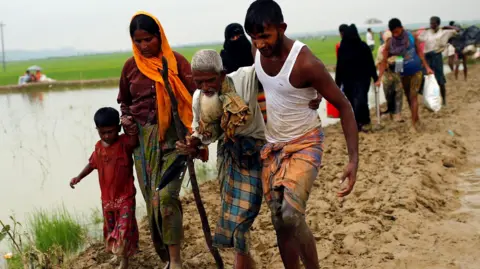
Thousands of Rohingya were killed, and over 700,000 fled to Bangladesh during an army crackdown in 2017. A damning UN report issued the following year stated top military figures in Myanmar should be investigated for genocide in Rakhine state and crimes against humanity elsewhere. Myanmar, under military control since a coup in 2021, has consistently claimed its operations targeted militant threats.
On Friday, Hlaing argued that Myanmar was not obliged to allow 'terrorists' free reign in northern Rakhine, where many Rohingya live. He stated that military clearance operations were warranted following attacks in the region.
The Gambia launched its case against Myanmar in 2019, motivated by its own history with a military government. Jallow described the Rohingya's suffering as a consequence of decades of persecution followed by a brutal military crackdown. He contended that the systematic killing and destruction of Rohingya villages cannot be justified as counterterrorism actions.
Lawyers representing The Gambia, backed by 57-nation Organisation of Islamic Cooperation, emphasized that the evidence points toward a genocidal intent behind Myanmar's actions. With more than a million Rohingya refugees currently in Bangladesh, the humanitarian crisis is dire.
In his statements, Hlaing expressed Myanmar's commitment to repatriating Rohingya refugees but lamented that external factors like COVID-19 have slowed progress. He warned that a finding of genocide would severely tarnish Myanmar's reputation. The ICJ has allocated three days for closed sessions to hear from Rohingya survivors, with a final ruling expected by the end of 2026. This case could set a precedent for future genocide cases, including the one initiated by South Africa against Israel.