In brief
Aung San Suu Kyi, the notable Burmese democracy advocate, has spent a total of 20 years in detention, predominantly in military prison. While her condition remains largely unknown, her influence endures as Myanmar grapples with the consequences of ongoing civil conflict, reflecting her lasting legacy even amid authoritarian rule.
Aung San Suu Kyi will mark 20 years of detention, five of which have followed the military coup that ousted her government in February 2021. Little is known about her current health or living conditions, yet the calls for her release continue to resonate within the country and abroad.
Her son, Kim Aris, expressed concerns about her wellbeing, stating, For all I know she could be dead, while military sources claim she is in good health. Notably, Suu Kyi has not met with her lawyers in over two years and has been sentenced to a total of 27 years on charges many regard as politically motivated.
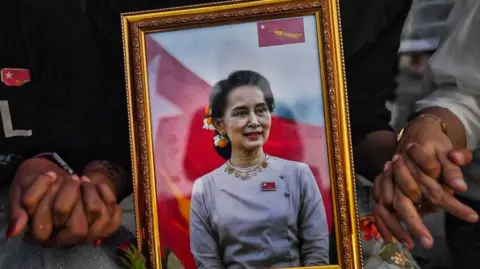
Even in her absence, Suu Kyi's shadow looms large over Myanmar. Supporters are advocating for her release and a cease to the military's aggressive tactics against opposition forces, pointing to a desperate need for dialogue to end the five-year civil war.
Despite efforts by the military to erase her influence, her image persists in various forms. Remnants of her campaign can still be found as faded posters of the revered figure continue to appear in hidden corners across the nation.
Historically, Suu Kyi's leadership was central to Myanmar's political landscape. Her prior struggles against the military's control led to previously unseen democratic reforms. However, the terrain has drastically changed. Current military leadership lacks any discernible reformist agenda, and the brutality used to suppress protests has radicalized many citizens, leading to armed resistance against the regime.
The generals projected their hold on power through sham elections, believing a cycle of control and manipulation would prevent Suu Kyi’s influence from resurfacing. Yet many citizens remain disenchanted with military rule and are torn between their lingering loyalty to her and the dire state of their nation under military governance.
As Myanmar continues to grapple with unrest and violence, questions remain over whether Suu Kyi could unite her country once more, should she ever gain her freedom again. Her combat for democracy remains a beacon of hope for many, despite the shadow of military oppression that looms over Myanmar.