In brief
A Paris court of appeal confirmed Marine Le Pen’s guilty verdict for misuse of public funds, but left her ban shortened, allowing her to launch a presidential campaign. Le Pen unveiled her “La Renaissance” theme, positioning herself as the voice of ordinary France against the establishment, while pointing to EU scepticism and NATO reluctance. Critics label her move a high‑stakes gamble, raising concerns about her potential need to wear an electronic tag and how that would affect campaign dynamics. With France poised to play a pivotal role in European power balances, many observers see Le Pen’s bid could reshape the upcoming election and, ultimately, EU policy directions.
France awakes on Wednesday, shockingly still reeling from last night’s political drama that involved Marine Le Pen, the National Rally’s figurehead. Within hours of a Paris court of appeal affirming her guilty verdict for misusing public funds, Le Pen publicly declared she would run for France’s presidency while launching a fresh social‑media campaign.
Her new poster—“Pour la France” (“For France”)—features the tricolour flag and a smiling Le Pen arms‑out‑stretched as if beckoning the nation. Headlines borrowed comparisons to the Titanic to capture the sense that “France is sinking” politically—yet her campaign promises a bright opposite called “La Renaissance” (Rebirth).
Le Pen has long presented herself as the listening, people‑oriented leader. She positions “The People” against the “Metropolitan Elite” or “Globalists,” a narrative listener’s President Emmanuel Macron has long fought to portray as the harder side of politics. Macron’s own party, Benoit’s Renaissance, directly contrasts with Le Pen’s “La Renaissance.”
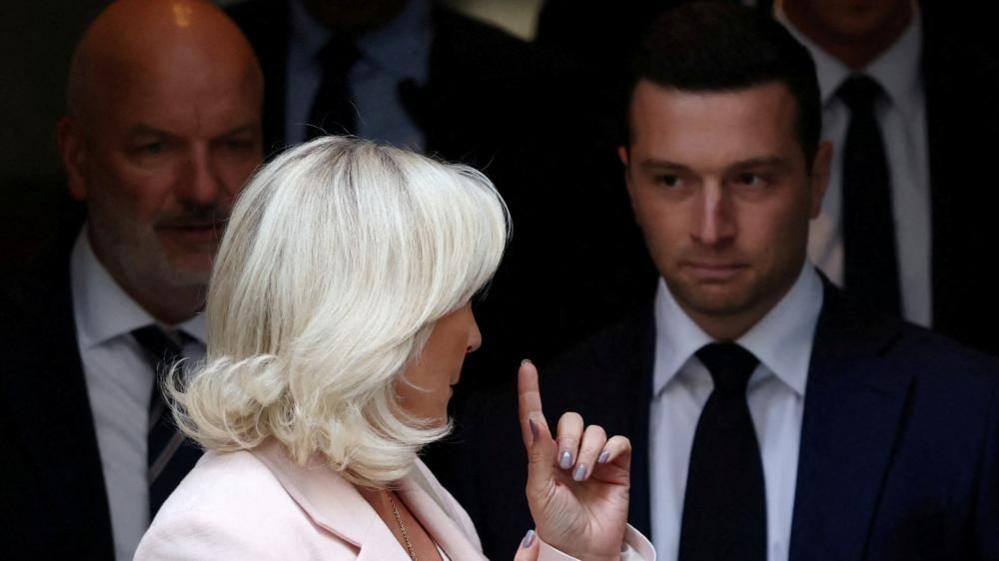
Even so, Israel’s political scoreboard shows a Roman-level popularity trend for Le Pen, who alone has never faced a third term limit but has lost twice in prior elections. Le Pen’s flirtation with a charismatic 30‑year‑old protégé, Jordan Bardella, underscores her moving for a robust political option in November’s election.
The Court of Appeal, which had originally imposed a five‑year ban, shortened the period, letting Le Pen decide whether to run while noting she might still wear an electronic tag—a constraint that could hamper her campaign moves during the final weeks.
In a France‑wide broadcast, Le Pen quipped: “I am running for president,” promising to challenge the verdict and resent her alleged past injustices. Critics, citing two proven embezzlement convictions that amassed over €4 million, urge that a convicted individual should stay away from the presidential office.
All eyes shift to whether France’s EU champion will be Macron or Le Pen—a decision that will reverberate beyond France’s borders, as the country’s power weight in the EU, NATO and relations with the United States loom large.