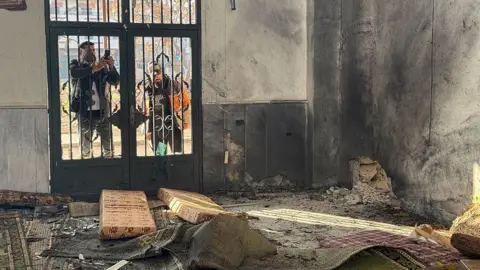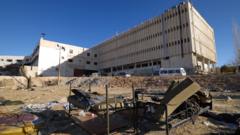
In the shadows of the grim Saydnaya prison, located just outside Damascus, the weight of despair hangs heavy. Renowned journalist Jeremy Bowen recounts the anguish faced by countless Syrians who endured unimaginable suffering within its walls during the Assad regime’s violent reign. Recent changes to the prison’s entrance—now adorned with the colors of the revolutionary flag—cannot conceal the chilling reality of its legacy.
More than 30,000 detainees are believed to have perished in Saydnaya alone, part of a staggering toll that exceeds 100,000 missing individuals since the civil war erupted in 2011. While other prisons under Assad’s rule exhibited slight niceties, Saydnaya emerged as the embodiment of cruelty, evoking fear and repression among the populace. Tales of torture, forced disappearances, and executions have knitted this institution into the very fabric of Syria’s traumatic history.
Bowen draws parallels with infamous prisons worldwide but asserts that Saydnaya stands apart due to its sheer brutality. Survivors recount harrowing experiences where they had to urinate into plastic bags, as basic hygiene was a luxury few could afford. With only ragged blankets for warmth, amassed testimonies serve as foreshadowing of further horrifying revelations yet to surface.
The journey towards truth involves documenting the atrocities committed within Saydnaya. A group of volunteers, led by musician Safana Bakleh, endeavor to collect fragmented records left amidst the chaos, hoping to illuminate the dark truths hidden for too long. For them, the urgency to supply grieving families with answers drives their efforts, as they conduct their own investigations in the absence of international oversight.
However, finding closure is a complex task as memories of harrowing conditions overwhelm visitors. Widad Halabi, a volunteer breaking down in tears, encapsulates the horror as she reflects on the daily plight of those imprisoned and tortured, expressing outrage at the brutality they suffered while the world moved on with its daily life.
The path towards justice remains fraught with obstacles, as many perpetrators, including Assad himself, have fled. Families searching for their loved ones express an insatiable hunger for accountability. Witnessing the chaos in Saydnaya stirs a collective longing for retribution, illustrating a desire to confront a past steeped in terror—holding accountable those who facilitated such horrors.
The enduring corruption of Assad's regime poisoned all levels of society, extending to prisons where graft thrived, exacerbating the already dismal plight of victims. Survivor Hassan Abu Shwarb recounts his experience and highlights the need for legal repercussions against captors, echoing the broader yearning among Syrians to reckon with their past.
With the tide turning against the oppressive regime, the new ruling entities understand that the future hinges on addressing the painful legacy of the past. Renewed calls for justice reverberate through the nation—families desperately seeking information and validation strive to reclaim agency over their narratives. The road to healing and rebuilding lies in confronting past horrors and ensuring that the fate of Saydnaya remains etched in the collective memory of a nation yearning for justice and restoration.
More than 30,000 detainees are believed to have perished in Saydnaya alone, part of a staggering toll that exceeds 100,000 missing individuals since the civil war erupted in 2011. While other prisons under Assad’s rule exhibited slight niceties, Saydnaya emerged as the embodiment of cruelty, evoking fear and repression among the populace. Tales of torture, forced disappearances, and executions have knitted this institution into the very fabric of Syria’s traumatic history.
Bowen draws parallels with infamous prisons worldwide but asserts that Saydnaya stands apart due to its sheer brutality. Survivors recount harrowing experiences where they had to urinate into plastic bags, as basic hygiene was a luxury few could afford. With only ragged blankets for warmth, amassed testimonies serve as foreshadowing of further horrifying revelations yet to surface.
The journey towards truth involves documenting the atrocities committed within Saydnaya. A group of volunteers, led by musician Safana Bakleh, endeavor to collect fragmented records left amidst the chaos, hoping to illuminate the dark truths hidden for too long. For them, the urgency to supply grieving families with answers drives their efforts, as they conduct their own investigations in the absence of international oversight.
However, finding closure is a complex task as memories of harrowing conditions overwhelm visitors. Widad Halabi, a volunteer breaking down in tears, encapsulates the horror as she reflects on the daily plight of those imprisoned and tortured, expressing outrage at the brutality they suffered while the world moved on with its daily life.
The path towards justice remains fraught with obstacles, as many perpetrators, including Assad himself, have fled. Families searching for their loved ones express an insatiable hunger for accountability. Witnessing the chaos in Saydnaya stirs a collective longing for retribution, illustrating a desire to confront a past steeped in terror—holding accountable those who facilitated such horrors.
The enduring corruption of Assad's regime poisoned all levels of society, extending to prisons where graft thrived, exacerbating the already dismal plight of victims. Survivor Hassan Abu Shwarb recounts his experience and highlights the need for legal repercussions against captors, echoing the broader yearning among Syrians to reckon with their past.
With the tide turning against the oppressive regime, the new ruling entities understand that the future hinges on addressing the painful legacy of the past. Renewed calls for justice reverberate through the nation—families desperately seeking information and validation strive to reclaim agency over their narratives. The road to healing and rebuilding lies in confronting past horrors and ensuring that the fate of Saydnaya remains etched in the collective memory of a nation yearning for justice and restoration.