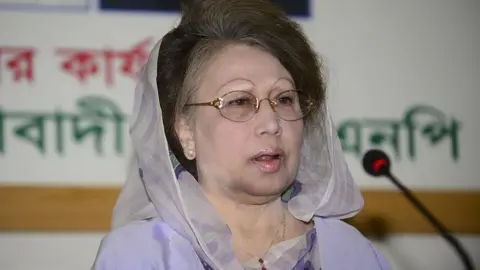
Khaleda Zia, who has died at the age of 80, was Bangladesh's first female prime minister.
Her husband, Ziaur Rahman, a leading figure in the country's struggle for independence, was president in 1977. At the time, Ms Zia was described as a 'shy housewife' devoted to their two sons.
But, following her husband's assassination in 1981, she rose to lead his Bangladesh Nationalist Party (BNP) and served two terms as prime minister - first in the 1990s and then in the early 2000s.
In the brutal world of Bangladeshi politics, she was accused of corruption and spent years in prison - but the charges were dropped after a 2024 uprising that saw her long-time rival, Sheikh Hasina, swept from power.
Begum Khaleda Zia was born in West Bengal in 1945.
The daughter of a tea trader, she moved to what is now Bangladesh with her family after the partition of India.
At the age of 15, she married Ziaur Rahman - then a young army officer.
In 1971, he joined a mutiny against West Pakistani forces and declared independence for Bangladesh.
After the military ceased power in 1977, Rahman - now the army chief of staff - declared himself president. He reintroduced political parties and a free media, and was later endorsed by popular vote.
In 1981, he was assassinated by a group of army officers in Chittagong.
Until then, Khaleda Zia had kept a low profile and seemed to take little interest in public life.
But she became a member of the BNP and rose to become its vice chairman. In 1982, Bangladesh began nine years of military dictatorship, and Ms Zia found herself organising the campaign for democracy.
In 1991, Khaleda Zia and the BNP became the largest party in post-military elections, and she was sworn in as prime minister. She made primary school free and mandatory for all.
However, in 2001, after having formed an alliance with Islamist parties, she was re-elected and introduced constitutional changes aimed at increasing women's representation in the legislature.
In the following years, she faced accusations of corruption and spent time in prison, but the charges were perceived as politically motivated.
Following her release in January 2025 on health grounds, Zia's legacy was evident as new political tides swept through Bangladesh. She passed away on December 30, 2025, leaving behind a significant political heritage.
}