In brief
James Watson, famed for his role in uncovering the double-helix structure of DNA alongside Francis Crick, has passed away at the age of 97. While he contributed profoundly to genetics, his later statements regarding race led to professional ostracism and controversy. His death was confirmed by Cold Spring Harbor Laboratory, where he served and researched before resigning amidst backlash. Watson shared the Nobel Prize in 1962 with Crick and Maurice Wilkins, acknowledging their monumental discovery of DNA's structure.
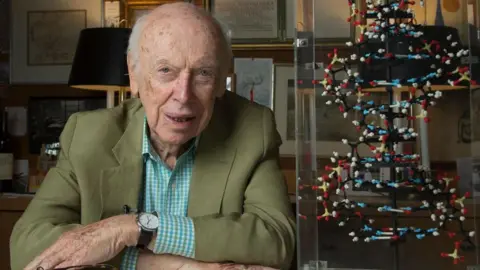
Nobel Prize-winning American scientist James Watson, one of the co-discoverers of the structure of DNA, has died aged 97.
In one of the greatest breakthroughs of the 20th Century, he identified the double-helix structure of DNA in 1953 alongside British scientist Francis Crick, setting the stage for rapid advances in molecular biology.
But Watson's reputation and standing were badly hurt by his comments on race and sex. In a TV programme, he made claims about genes causing a difference in average IQ between black and white people.
His death was confirmed by Cold Spring Harbor Laboratory, where he worked and researched for decades, before having to resign as its chancellor over the comments.
Watson shared the Nobel in 1962 with Maurice Wilkins and Francis Crick for the DNA's double helix structure discovery.
We have discovered the secret of life, they said at the time.
By the early 2000s, he had been largely ostracised by the scientific community over his comments on race and gender.
In 2007, the scientist told the Times newspaper that he was inherently gloomy about the prospect of Africa, because all our social policies are based on the fact that their intelligence is the same as ours - whereas all the testing says not really.
He apologised unreservedly, but nevertheless, the comments led to him losing his job as chancellor at Cold Spring Harbor Laboratory in New York.
Additional comments he made in 2019 - when he once again suggested a link between race and intelligence - led to the lab stripping his honorary titles of chancellor emeritus, Oliver R Grace professor emeritus and honorary trustee.
Dr Watson's statements are reprehensible, unsupported by science, the laboratory said in a statement at the time.
DNA was discovered in 1869 but it took until 1943 for scientists to discover that it made up the genetic material in cells. Still, the structure of DNA remained a mystery. Working with images obtained by King's College researcher Rosalind Franklin, without her knowledge, Crick and Watson were able to construct a physical model of the molecule.
Maurice Wilkins, who shared the Nobel with Crick and Watson, had worked with Franklin to determine the DNA molecule's structure. Franklin, who died in 1958, is today recognised for the integral role she played in the scientific breakthrough of DNA research, despite her work largely being written out of the story at the time.
Former colleagues have commented that Watson nurtured the careers of female scientists at Harvard in the 1950s and 60s, at a time when that was not the norm. However he also made disparaging comments about women in science, and wrote sexist remarks about Franklin, including commenting on her appearance, in his 1968 best-selling book, The Double Helix.
Watson became the first living Nobel laureate to sell his gold medal, fetching $4.8m (£3.6m) at an auction in 2014, saying he was letting go of it because he felt ostracised by the scientific community after his controversial remarks. A Russian billionaire bought it for $4.8m and promptly gave it back to him.