The Australian, British and American defence ministries announced today a new unmanned undersea vehicle (UUV) programme that will entitle them to cutting‑edge payloads, sensors and weapons systems capable of protecting undersea cables, striking targets and carrying out surveillance, reconnaissance and logistics missions.
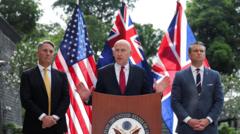
For too long in AUKUS we talked too much and delivered too little, British Defence Secretary John Healey said at the Shangri‑la Dialogue in Singapore, confirming that the United Kingdom will be injecting £150 million (roughly $201 million) into the total roll‑up.
The UUV project is the first flagship initiative of Pillar Two of the AUKUS defence pact, the partnership that began in 2021 and is designed to counter China’s expanding maritime ambition in the Indo‑Pacific.
**Why Undersea Infrastructure Matters**
Undersea cables—water‑borne fibre optics and pipelines—carry a staggering 97 % of international data traffic and power countless global services. Their protection has become a geopolitical battleground, with reports of increased Russian submarine visits around UK cables and suspected sabotage by Chinese naval forces around Taiwan and Sweden.
The new partnership aims to deploy UUVs that can enter hostile waters, detect threats to the seabed networks and, if necessary, neutralise them before they cripple the backbone of the world’s communications.
**Speed, Capability and Full‑Spectrum Operations**
A UUV that can operate quietly miles beneath the surface would enable the Allied navies to conduct precision strikes while simultaneously gathering actionable intelligence on submarine movements. The joint statement said the drones would be equipped with advanced sensors and weapons and would quickly provide the forces with ‘advanced battle technologies’.
“Building these systems will enhance deterrence not only in the Pacific but also across the Atlantic, and in the high northern latitudes, where Russia’s footprint is growing,” Healey added.
**Strategic Context**
The announcement follows a month after UK defence ministers accused Russia of a covert operation over cables and pipelines north of the UK – allegations Moscow has denied. In December, the UK and Norway signed a pact to hunt Russian submarines in the North Atlantic, as the UK has 60 undersea cables subject to heightened threat from Russian patrol vessels.
Separately, China has long been suspected of damaging undersea cables in the waters surrounding Taiwan, the South China Sea, and even the Baltic Sea, raising a global alarm over the integrity of worldwide digital infrastructure.
**Responses and Future Outlook**
During the summit, the defence ministers did not respond to BBC questions on whether the UUV programme was a direct counter‑measure against Russian or Chinese submarine activity, nor did they address criticism about AUKUS’s slow progress in past‑tale projects.
Peter Hegseth, the US Defence Secretary, confirmed that the U.S. and the UK will be rotating nuclear‑powered submarines through Australia as part of the broader AUKUS initiative, with the first U.S. Navy personnel arriving later this year. Australian Defence Minister Richard Marles underscored the timeline, claiming that the HMAS Stirling naval base will be ready for submarine rotations by end‑2027.
In light of the new UUV focus, the three nations have emphasised that AUKUS’s mission to upgrade maritime capabilities will continue unabated, ensuring that their shared fleet and technology stack can pre‑empt threats in critical undersea domains.
— AUKUS has pledged to ship UUVs by next year, providing modern undersea asset protection for a strategic infrastructure that anchors the global economy.
For too long in AUKUS we talked too much and delivered too little, British Defence Secretary John Healey said at the Shangri‑la Dialogue in Singapore, confirming that the United Kingdom will be injecting £150 million (roughly $201 million) into the total roll‑up.
The UUV project is the first flagship initiative of Pillar Two of the AUKUS defence pact, the partnership that began in 2021 and is designed to counter China’s expanding maritime ambition in the Indo‑Pacific.
**Why Undersea Infrastructure Matters**
Undersea cables—water‑borne fibre optics and pipelines—carry a staggering 97 % of international data traffic and power countless global services. Their protection has become a geopolitical battleground, with reports of increased Russian submarine visits around UK cables and suspected sabotage by Chinese naval forces around Taiwan and Sweden.
The new partnership aims to deploy UUVs that can enter hostile waters, detect threats to the seabed networks and, if necessary, neutralise them before they cripple the backbone of the world’s communications.
**Speed, Capability and Full‑Spectrum Operations**
A UUV that can operate quietly miles beneath the surface would enable the Allied navies to conduct precision strikes while simultaneously gathering actionable intelligence on submarine movements. The joint statement said the drones would be equipped with advanced sensors and weapons and would quickly provide the forces with ‘advanced battle technologies’.
“Building these systems will enhance deterrence not only in the Pacific but also across the Atlantic, and in the high northern latitudes, where Russia’s footprint is growing,” Healey added.
**Strategic Context**
The announcement follows a month after UK defence ministers accused Russia of a covert operation over cables and pipelines north of the UK – allegations Moscow has denied. In December, the UK and Norway signed a pact to hunt Russian submarines in the North Atlantic, as the UK has 60 undersea cables subject to heightened threat from Russian patrol vessels.
Separately, China has long been suspected of damaging undersea cables in the waters surrounding Taiwan, the South China Sea, and even the Baltic Sea, raising a global alarm over the integrity of worldwide digital infrastructure.
**Responses and Future Outlook**
During the summit, the defence ministers did not respond to BBC questions on whether the UUV programme was a direct counter‑measure against Russian or Chinese submarine activity, nor did they address criticism about AUKUS’s slow progress in past‑tale projects.
Peter Hegseth, the US Defence Secretary, confirmed that the U.S. and the UK will be rotating nuclear‑powered submarines through Australia as part of the broader AUKUS initiative, with the first U.S. Navy personnel arriving later this year. Australian Defence Minister Richard Marles underscored the timeline, claiming that the HMAS Stirling naval base will be ready for submarine rotations by end‑2027.
In light of the new UUV focus, the three nations have emphasised that AUKUS’s mission to upgrade maritime capabilities will continue unabated, ensuring that their shared fleet and technology stack can pre‑empt threats in critical undersea domains.
— AUKUS has pledged to ship UUVs by next year, providing modern undersea asset protection for a strategic infrastructure that anchors the global economy.