In brief
The first touch of delivery robots on Chicago’s sidewalks sparked excitement—now it has turned into a safety crisis. Residents report families being forced off narrow footpaths, and incidents of collisions are spreading through cities in the US and abroad. Local governments are taking different actions, from fencing robots out to restricting them to quieter zones. Trade unions warn of job losses as bots replace human delivery workers. With projections of millions of robots operating globally by 2034, citizens demand safer regulations and thorough testing.
The first time John Roberts, a Chicago resident, saw a delivery robot sliding down a city block, he was intrigued. "I actually thought they were kind of neat – it felt futuristic," he recalled, capturing the early excitement surrounding autonomous urban couriers.
That enthusiasm soured once a robot’s lights flickered next to his family while they walked down a shared‑use pedestrian strip. "We had to get out of the way," Roberts said, highlighting the safety concerns that are sparking widespread backlash.
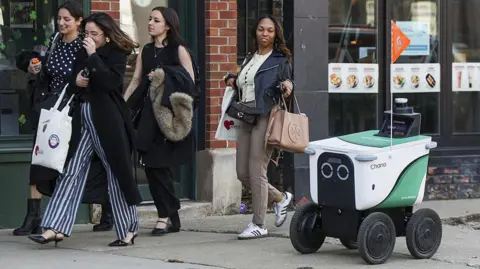
Autonomous delivery vehicles are now found on sidewalks in numerous cities—from Chicago and Pittsburgh to Sheffield, Toronto, Seoul and San Francisco. While companies claim the machines use cameras, sensors and GPS to navigate safely and reduce traffic emissions, incidents of collisions, erratic behaviour and even injury are increasing.
Local authorities have responded in differing ways. San Francisco has restricted robot activity to quieter areas, Toronto banned them from sidewalks altogether, and Chicago now forbids them in two neighbourhoods. Some cities like Glendale, California, are considering temporary bans after reports of robots blocking pedestrians or malfunctioning.
Beyond pedestrian safety, labour unions in the UK fear job loss. The Independent Workers Union of Great Britain warns about widespread outsourcing of delivery work to autonomous bots, emphasising the need for regulation to protect workers and public space.
Industry experts predict growth nonetheless: a Transforma Insight report forecasts 2.1 million robots worldwide by 2034. With that future ahead, residents say they must demand clear safety tests, operational limits and insurance requirements.
Roberts has launched a petition seeking a blanket ban across Chicago while urging the city to develop comprehensive rules for the robots’ use. His campaign, which currently gathers thousands of signatures, shows that even as technology advances, public consensus and regulation remain critical.
For now, the city’s crowded streets are a proving ground for the balance between innovation and everyday life—an ever‑shifting landscape that might dictate how autonomous delivery bots will coexist with pedestrians.