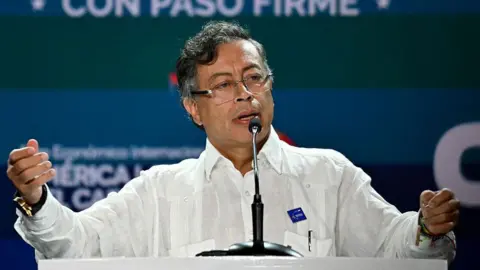
Colombian President Gustavo Petro is heading to Washington for a high-stakes trip to meet US President Donald Trump, the first in-person meeting between the two after months of escalating tensions and angry rhetoric.
Venezuela, drug trafficking, oil, security and US strikes on alleged drug vessels will be high on the agenda when they meet at the White House on Tuesday.
While the two men were cordial in a phone call after the 3 January US military operation to seize Venezuela's President Nicolás Maduro, Petro has since said he believes that there is a real threat of military action against Colombia.
Trump, for his part, has previously said that a military operation in Colombia sounds good.
Tuesday's meeting follows months of the two leaders trading barbs - with Petro repeatedly criticizing the repeat US strikes on the alleged drugs boats in the Caribbean and Pacific, as well as the White House's immigration policies.
In an interview with the BBC last month, Petro went as far as to compare US Immigration and Customs Enforcement (ICE) agents to Nazi brigades and accused the US of treating other countries as part of its empire.
On the US side, Trump has accused Petro's government of not doing enough to stop the flow of cocaine heading north and has vowed to expand strikes to land targets across the region.
But the acrimony seemed to dissipate following a cordial phone call between the two leaders, which a Colombian official later described as an 180-degree turn from both sides.
One man - Rand Paul, US Senator for Kentucky - was instrumental in setting up the conversation. Paul expressed his belief in diplomacy and the need for improved relations.
Among other topics, the meeting will address security concerns regarding the National Liberation Army (ELN), a guerrilla group that operates along the Colombian-Venezuelan border and poses challenges for both countries.
Despite previous tensions, cooperation between the Colombian and US militaries has persisted, as has collaboration between the DEA and Colombian police.
Ultimately, this meeting represents a critical opportunity for both leaders to navigate their complex and often contentious relationship, potentially laying the groundwork for more effective cooperation in areas of mutual concern.