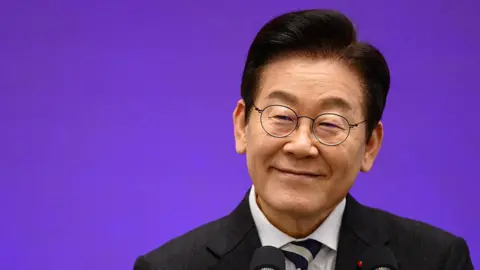
Lee Jae–myung has emerged from South Korea's recent political crisis as a frontrunner to be the next president. Before the events of 3 December 2024, Lee's path to South Korea's presidency was littered with obstacles. Ongoing legal cases, investigations for corruption, and allegations of abusing power all looked set to derail the former opposition leader's second presidential bid. Then a constitutional crisis changed everything.
On that night, former president Yoon Suk Yeol's abortive attempt to invoke martial law set in motion a series of events that appears to have cleared the path for Lee. Now, as the Democratic Party candidate, he is the frontrunner to win South Korea's election on 3 June. It's a dramatic reversal of fortunes for the 61-year-old, who at the time of Yoon's martial law declaration stood convicted of making false statements during his last presidential campaign in 2022.
Those charges still cast a long shadow over Lee and could yet threaten his years-long pursuit of the top job. But they are also just the latest in a string of controversies that have dogged him throughout his political career. The rags-to-riches origin story combined with a bullish political style has made Lee into a divisive figure in South Korea. "Lee Jae-myung's life has been full of ups and downs, and he often takes actions that stir controversy," Dr Lee Jun-han, professor of political science and international studies at Incheon National University, tells the BBC.
These actions typically include attempts at progressive reform – such as a pledge made during his 2022 presidential campaign to implement a universal basic income scheme – which challenge the existing power structure and status quo in South Korea. "Because of this, some people strongly support him, while others distrust or dislike him," Dr Lee says. “He is a highly controversial and unconventional figure – very much an outsider who has made a name for himself in a way that doesn't fit traditional Democratic Party norms."
Lee's humble origins and controversial political style have made him a divisive figure. In a recent memoir, Lee described his childhood as "miserable." Born in 1963 in a mountain village in Andong, Gyeongbuk Province, he was the fifth of five sons and two daughters and - due to his family's difficult circumstances - skipped middle school to illegally enter the workforce. As a young factory worker, Lee suffered an industrial accident where his fingers got caught in a factory power belt and at the age of 13 suffered a permanent injury to his arm after his wrist was crushed by a press machine.
Lee later applied for and was allowed to sit entrance exams for high school and university, passing in 1978 and 1980 respectively. He went on to study law with a full scholarship, and passed the Bar Examination in 1986. In 1992, he married his wife Kim Hye-kyung, with whom he has two children. He worked as a human rights lawyer for almost two decades before entering politics in 2005, joining the social-liberal Uri Party, a predecessor of the Democratic Party of Korea and the ruling party at the time.
While his poor upbringing has drawn scorn from members of South Korea's upper class, Lee's success in building his political career from the ground up has earned him support from working-class voters and those who feel disenfranchised by the political elite. He was elected mayor of Seongnam in 2010, rolling out a series of free welfare policies during his tenure, and in 2018 became governor of the broader Gyeonggi Province. Lee would go on to receive acclaim for his response to the COVID-19 pandemic, during which he clashed with the central government due to his insistence on providing universal relief grants for all residents of the province.
South Korea's presidential race entered a new phase after Yoon's martial law declaration, which was a drastic response to mounting pressures that his administration was facing. This move, intended to combat "anti-state forces" and perceived North Korean sympathizers, backfired and led to Lee emerging as a strong voice against the government. Within hours of the declaration, he appealed to the public via a live-streamed broadcast and urged them to assemble in protest outside the National Assembly building in central Seoul. Thousands responded, clashing with police and blocking military units, as opposition members rushed to the assembly building to thwart Yoon's orders.
Once the martial law was lifted, the Democratic Party swung into action to impeach Yoon, a move later upheld by the Constitutional Court. Consequently, Lee announced his intent to run for president as he resigned from his party leadership role. With support from party members in the primary, he secured his candidacy amid the chaos that followed Yoon's controversial actions.
However, Lee's path remains fraught with peril as he navigates multiple scandals and a complex legal landscape. In January 2024, he survived an assassination attempt, a brutal reminder of the deepening polarization within South Korean society that has become evident among voters. This environment has also raised questions about the future of South Korea's political climate as the election date looms, showcasing the intertwining of chaos and opportunity in the pursuit of leadership. With unresolved legal battles looming over him, Lee stands as a controversial yet favored candidate, awaiting the judgment of both the electorate and the courts.