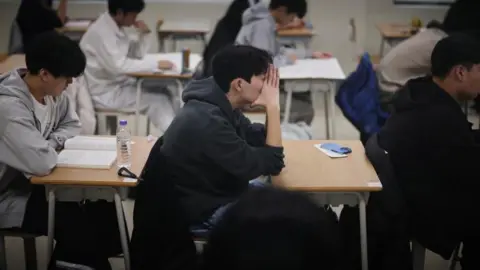
The English section of South Korea's gruelling college entrance exam, or Suneung, is notoriously difficult, with some students comparing it to deciphering an ancient script, and others calling it 'insane'.
So intense was the criticism around this year's test that the top official in charge of administering it resigned to take responsibility for the 'chaos' it caused.
'We sincerely accept the criticism that the difficulty of questions... was inappropriate,' said Suneung chief Oh Seung-geol, adding that the test 'fell short' despite having gone through several rounds of editing.
Among the most daunting questions are one on Immanuel Kant's philosophy of law and another involving gaming jargon.
The latter, worth three points, asks students to pick where a sentence should fit in a given paragraph. One student described the experience as taking a long time to figure out the questions, indicating a level of confusion prevalent among test-takers.
This year, just over 3% of test-takers achieved the highest grade in the English section, a drop from 6% the previous year, further highlighting the challenges posed by the exam.
Critics and teachers alike have suggested that the test's structure prioritises memorization and test-taking tricks over genuine English proficiency, leading to concerns about its educational relevance.
South Korea's Suneung is a crucial determining factor for university admission, greatly affecting students' futures, and its challenging nature has drawn attention both domestically and internationally.
Only four of the 12 Suneung chiefs since the exam debuted in 1993 have served out their full three-year terms, indicating a turbulent administration history.