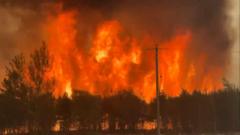
A military aircraft, alongside helicopters, is urgently evacuating residents from the Canadian province of Manitoba as wildfires intensify. Thousands have left their homes in western Canada, particularly within the central prairie provinces of Manitoba and Saskatchewan, with firefighters battling flames amid predictions of hot, dry weather ahead. Currently, over 180 wildfires are reported, and dense smoke has drifted across Canada and even parts of the US, prompting both Saskatchewan and Manitoba to declare states of emergency and call for international assistance.
Recent aerial footage highlights the enormous smoke plumes generated by these wildfires. Several regions in Alberta and British Columbia have also mandated evacuations due to the fire spread. The situation has escalated significantly for the northern First Nations community of Pukatawagan, with a Manitoba official describing the evacuation efforts as "rapidly evolving." The Canadian Armed Forces, along with the Manitoba Wildfire Service and Heavy Urban Search and Rescue Team, are working to transport over 2,000 individuals to safety. In the town of Flin Flon—home to about 5,000 residents—only firefighters and essential workers remain due to the ongoing crisis.
Manitoba’s fire situation report indicates that there are currently 25 active fires within the province, ten of which are classified as out of control. Saskatchewan is also grappling with its own blazes, with 16 wildfires reported, seven of which remain uncontained. The Canadian Interagency Forest Fire Centre has designated conditions in Saskatchewan as extreme.
Danielle Desjardins, a meteorologist with Environment and Climate Change Canada based in Winnipeg, expressed concerns over the forecast, noting a cold front's arrival might not provide relief. Instead, it is expected to bring strong winds, which paired with high temperatures and minimal rainfall set the stage for further wildfire expansion.
The impacts of the wildfire crisis extend beyond Canada, as smoke has resulted in elevated air quality concerns affecting an estimated 22 million Americans this weekend. States like Michigan and Wisconsin have issued advisories, while northern Minnesota residents have been cautioned about potentially unhealthy smoke levels statewide.
2023 has marked a record wildfire season for Canada, devastating over 42 million acres. While wildfires are a natural occurrence in numerous regions, the United Nations climate body asserts that climate change is amplifying the conditions necessary for these fires to thrive. The extreme and prolonged heat has been depleting moisture from both the ground and vegetation, creating a precarious scenario for the months ahead.