In brief
In a remarkable archaeological find, a hidden Maya city named Valeriana was discovered in the jungles of Campeche, Mexico, by a PhD student using Lidar technology. This ancient city, likely home to up to 50,000 people at its peak, challenges prior perceptions of Maya civilizations and sheds light on their complex urban planning.
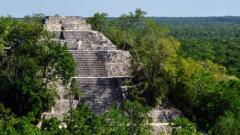
The article text: A significant archaeological discovery has revealed a lost Maya city in the dense jungles of Campeche, Mexico, accidentally identified by a PhD student while researching online. The site, named Valeriana, showcases elaborate structures including pyramids, sports fields, and causeways, and is believed to be the second densest Maya site after Calakmul.Luke Auld-Thomas, studying at Tulane University, stumbled upon Lidar data during an internet search. Lidar, or Light Detection and Ranging, uses laser pulses from aircraft to create precise maps of landscapes beneath vegetation. Upon analyzing the data, Auld-Thomas detected a sprawling ancient city, which could have supported a population of 30,000 to 50,000 individuals during its peak from 750 to 850 AD.The team chose the name Valeriana in reference to a nearby lagoon. This finding is significant, as it refutes the misconception that tropical regions were lacking in complex civilizations. Prof. Marcello Canuto, a collaborator on the project, underscored that these regions were indeed inhabited by advanced cultures. While the precise reasons for Valeriana's abandonment remain unclear, the researchers suggest climate change may have played a substantial role. Interestingly, Valeriana is situated just minutes away from a major road, yet remains largely untouched and unexplored.Encompassing approximately 16.6 square kilometers, Valeriana featured numerous large buildings, plazas with temple pyramids, and a court for ancient ball games. A reservoir also indicates advanced water management practices among its inhabitants. The discovery of 6,764 structures across three sites amplifies the understanding of Mayan civilization's complexity. Prof. Elizabeth Graham of University College London noted that such evidence supports the idea that many Maya lived in urban centers rather than isolated villages.As climate change and European colonization played roles in the region's societal changes, the Lidar technology brings to light not just Valeriana but also potential many more uncharted sites. Prof. Canuto emphasizes the technology's revolutionizing impact on archaeological surveys of regions once hidden beneath dense flora. While excitement surrounds the prospect of exploring Valeriana, Auld-Thomas cautions that the sheer number of newly discovered sites means that excavation of all remains unfeasible. The research's findings have been formally published in the journal Antiquity, paving the way for further exploration into these once-obscured civilizations.