In brief
In Central Kalimantan, relentless peat fires blanket Borneo in a choking aerosol haze that has sickened more than 277,000 people, including 62,000 young children. Parents fear for their families as the smog turns day into blood‑red sunsets and night into a murky, rust‑tinged darkness. Despite government fire‑fighting efforts, water shortages and expanding fire fronts leave residents trapped indoors, with little relief on the horizon. The crisis underscores the urgent need for better forest management, emergency air‑quality monitoring and international pressure on Indonesia to protect its peatlands.
The sky over Central Kalimantan has turned a tawny copper shade, turning streets and homes into ghostly silhouettes lit by a soft, rust‑hued haze. Where once rain‑kissed trees and rivers ran clear, oil‑black smoke now drifts heavy and inky across the archipelago.
Mother‑of‑three Dianyra Eka Nastiti watches her little boys sleep while the night air thickens. She has already seen her baby hospitalized for bronchopneumonia at just a month and a half old. “Will my child cough tomorrow?” she wonders, the thought haunting her at each dawn.
The haze is produced by fires that have scorched roughly 1.9 million hectares this year – about the size of New Jersey – and released toxic particles and carbon monoxide that travel far beyond Indonesia’s borders. Singapore, Malaysia and the Philippines now suffer from daylight visibilities bowed to yellow‑tinted tracks.
Health officials report 277,000 cases of cough and acute respiratory infections, 62,000 of which are children under five. Local health officers warn that invisible pollutants travel deep into lungs and bloodstream, inflaming chronic conditions and raising premature death risk.
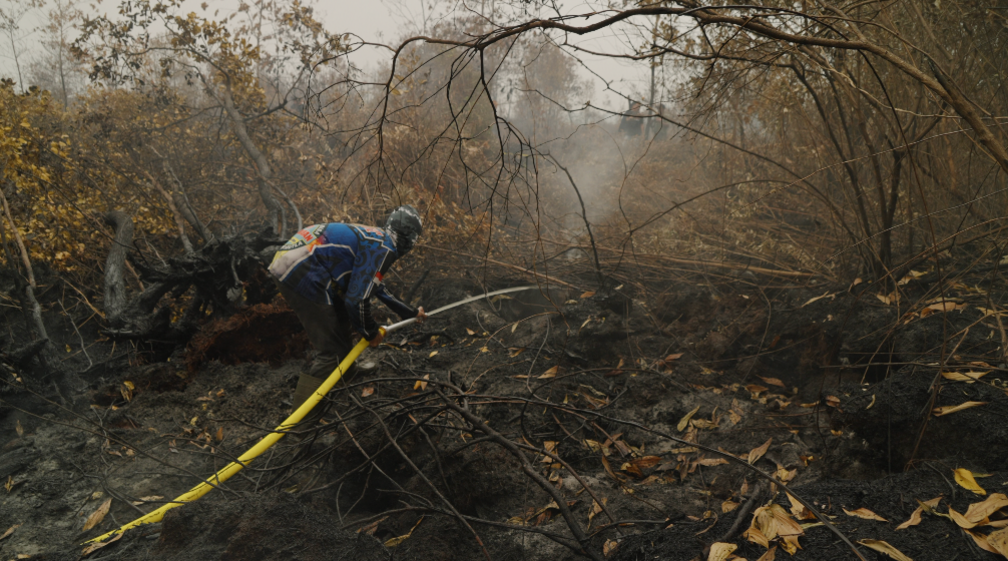
Firefighters have been battling the char‑broad blazes for months, but the peat‑rich soil, laced with deep reservoirs of carbon, keeps the fire smoldering underground. Water is scarce in a region experiencing a Super El Nino‑driven drought; every bucket now becomes a precious commodity.
With every new dawn, the sky’s colour deepens from dusty grey to amber, even orange when the ground reacts violently to the rising heat. Families have no choice but to lock themselves inside. “They can’t go out to school or play; they have to stay at home,” Dianyra explains, a note of hope creeping into her voice as she holds her children close.
Smoky air forces residents to run errands as quickly as possible – buying groceries, school supplies, medicine – while women like Lola Macitri from a nearby village drive to a dry meeting ground, glancing at a textbook through a white face mask. Even the simple act of coughing becomes a public health concern, and medical staff fill hospital wards with patients who cannot breathe a clean breath.
The government claims it has deployed over 60,000 personnel in “land operations” and claims 80% success in extinguishing new fires. Yet officials concede that only surface flames are visible; the deep peat continues its hidden char. “We need every tool – from water drops to weather manipulation – to save our skies,” an environmental scientist records.
Residents on the frontlines anticipate the coming first heavy wet spell, knowing that only rain can finally kill the peat’s lingering embers. Yet hopes are tempered by the knowledge that wildfire “sinks a ship” and that new fires keep emerging in areas previously untouched.
The crisis extends beyond the local, reminding Southeast Asia that the planet’s carbon reserves and health safety net are at risk when peatlands are carved and stripped. As the skies over Borneo continue to blaze, urgent steps are required to transition from reactionary firefighting to proactive land stewardship.