In brief
Utilizing satellite data and advanced physics, researchers have created the most detailed map of Antarctica's underbelly yet, revealing intricate landscapes beneath the ice. This new information could be vital in understanding how Antarctica will react to climate change and the implications for global sea levels.
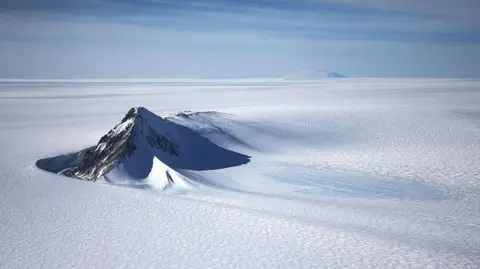
A new map has unmasked the landscape beneath Antarctica's ice in unprecedented detail, something scientists say could greatly enhance our understanding of the frozen white continent.
Researchers used satellite data and the physics of how Antarctica's glaciers move to work out what the continent might look like beneath the ice. They found evidence of thousands of previously undiscovered hills and ridges, and say their maps of some of Antarctica's hidden mountain ranges are clearer than ever before.
While the maps are subject to uncertainties, the researchers believe the new details could shed light on how Antarctica will respond to climate change - and what that means for sea-level rise.
It's like before you had a grainy pixel film camera, and now you've got a properly zoomed-in digital image of what's really going on, lead author Dr. Helen Ockenden, a researcher at the University of Grenoble-Alpes, told BBC News.
Thanks to satellites, scientists have a good understanding of Antarctica's icy surface – but what lies beneath has remained more of a mystery. In fact, more is known about the surface of some planets in our Solar System than much of Antarctica's underbelly – the topography beneath the ice sheet.
But researchers now have what they believe to be the most complete, detailed map of that underbelly ever made. Prof Robert Bingham, a glaciologist at the University of Edinburgh and co-author of the study, described the revelations as amazing.
Traditional measurements from the ground or air have used radar to see beneath the ice - which is up to three miles (4.8km) thick in places - often along individual survey lines. Researchers have finally managed to fill in the gaps using a new method that combines their knowledge of the ice surface from satellites with their understanding of ice movement physics.
The mapping process has unveiled tens of thousands of previously undiscovered features, changing our perception of Antarctica's geology and aiding in forecasting future climate scenarios.
Despite the uncertainties in their assumptions, researchers believe that these advancements will lead to better models predicting how quickly glaciers may melt and contribute to global sea-level rise.