In brief
This article examines President Trump's reliance on instinct in the ongoing war against Iran, revealing the challenges he faces as the conflict unfolds. Historical references highlight the unpredictability of warfare and the importance of strategic planning, juxtaposed with the Iranian regime's resilience in the face of US military power.
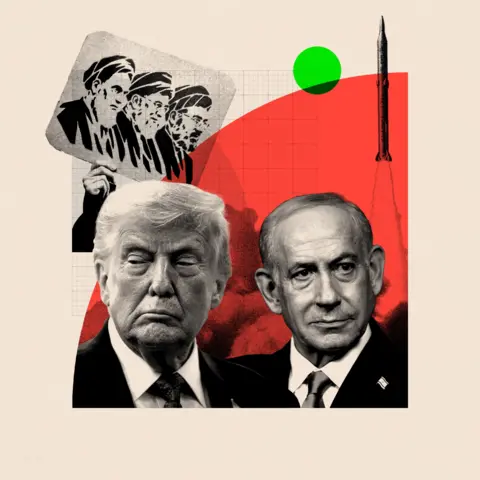
Some old truths about warfare have been knocking on the door of the Oval Office in the month since US President Donald Trump and Israel's Prime Minister Benjamin Netanyahu sent US and Israeli warplanes to bomb Iran.
The failure to learn from the past means that Donald Trump now faces a stark choice. If he cannot get a deal with Iran, he can either try to declare a victory that will fool no one or escalate the war.
The oldest of the old truths comes from the Prussian military strategist Helmuth von Moltke the Elder: 'no plan survives first contact with the enemy.' He was writing in 1871, the year Germany was unified as an empire, a moment that was as consequential for the security of Europe as this war might be for the security of the Middle East.
Maybe Trump prefers the boxer Mike Tyson's modern version: 'everyone has a plan until they get hit.' Even more relevant for Trump are the words of one of his predecessors, Dwight D. Eisenhower, the American general who commanded the D-Day landings in 1944 and went on to serve two terms as a Republican president of the United States in the 1950s.
Eisenhower's version was 'plans are worthless, but planning is everything.' He meant that the discipline and process of making plans to fight a war make it possible to change course when the unexpected happens.
For Trump, the unexpected item has been the resilience of the regime in Iran. It seems that he was hoping for a repeat of the US military's lightning-fast kidnap in January of the President of Venezuela Nicolás Maduro and his wife, Cilia Flores. They are now in prison in New York, facing trial. Maduro's deputy Delcy Rodríguez replaced him as president and is taking orders from Washington.
Hoping for a repeat of the victory over Maduro suggests a yawning lack of comprehension of the differences between Venezuela and Iran.
Eisenhower's adage on thinking ahead came in a speech in 1957. He had been the man in charge of planning and commanding the largest amphibious military operation in history, the invasion of western Europe on D-Day, so he knew what he was talking about.
He went on to explain that when an unexpected emergency arises 'the first thing you do is to take all the plans off the top shelf and throw them out the window and start once more. But if you haven't been planning you can't start to work, intelligently at least.'
Far from capitulating or collapsing after Israel and the US killed Iran's Supreme Leader Ayatollah Ali Khamenei on the first air strike of the war, the regime in Tehran is functioning and fighting back. It is playing a weak hand well.
In contrast, Trump has given the impression that he is making it up as he goes along. He follows gut instincts, not the pages of intelligence and strategic advice that other presidents have ploughed through.
Thirteen days into the war, Trump was asked by Fox News Radio when the war would end. He answered that he did not think that the war 'would be long.' As for ending it, it would be 'when I feel it, feel it in my bones.'
He relies on an inner circle of advisers who are in their jobs to back up his decisions and make them happen. Speaking truth to power is not, it seems, in their job description. Relying on the president's instincts rather than a well-worked set of plans – even if they must be adapted or discarded – makes it harder to fight a war. The lack of clear political direction blunts the devastating firepower and effectiveness of the US armed forces.
Four weeks ago, Trump and Netanyahu put their faith in a ferocious bombing campaign that killed not just the supreme leader but his closest advisors and has so far killed 1,464 Iranian civilians, according to HRANA, a US-based group that monitors human rights violations in Iran. The two leaders were expecting a quick victory. Both challenged Iranians to follow up their bombs with a popular uprising to topple the regime.
It is hard to overstate how much the Iranian regime has endured – both from the United States and global criticism – yet still stands today. As international observers note, they may endure more casualties than their leadership can tolerate, but the regime remains steadfast in its operations.
While Trump appears to be reliant on impulse, the Iranian regime has shown a capability to adapt and react, turning the tide against the expectations of swift capitulation. The complexities surrounding geopolitical dynamics and leadership strategies reveal underlying tensions that may shape the outcome of this ongoing conflict.