In brief
In a recent announcement at the White House, President Donald Trump celebrated the revocation of an Obama-era policy that recognized the threat of pollution to public health and the environment. This move represents an extensive rollback of climate regulations, reinforcing Trump's long-standing critique of Democratic environmental policies as overly radical. Aimed at boosting fossil fuels, the decision has faced significant backlash from environmental groups and Democrats, who argue it jeopardizes efforts to combat climate change. With midterm elections approaching, Trump's focus on economic benefits from deregulation seeks to position the Republican Party favorably, even as public concern over climate change continues to rise.
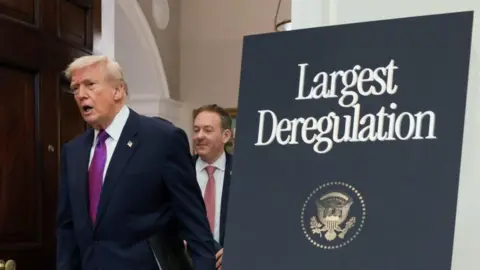
US President Donald Trump framed his sweeping rollback of federal climate change policy on Thursday as a political win over the Democratic Party's 'radical' environmental agenda. This latest announcement at the White House marks one of the most significant moves of his second term, as Trump revoked an Obama-era 'endangerment finding' from 2009, which held that pollution harms public health and the environment.For nearly 17 years, the US had utilized that scientific finding as the legal basis to implement policies aimed at reducing emissions from various sources, including cars and power plants. Trump referred to the Obama-era rule as the basis for what he termed the 'Green New Scam', a term often used by Republicans to describe Democratic environmental reforms.The decision signifies Trump’s ongoing effort to dismantle policies that both Democrats and climate experts agree are crucial in combating climate change. The rollback represents one of the most extensive reversals of American climate policy to date.The move was described as a strategic win for the Republican agenda as the midterms approach, underscoring Trump’s narrative against what he portrays as job-killing regulations imposed by Democrats. In his remarks, Trump argued that boosting fossil fuel usage over clean energy would ultimately lower energy costs for consumers.Lee Zeldin, the administrator of the US Environmental Protection Agency, joined Trump in announcing the decision, declaring it as the 'single largest act of deregulation in the history of the United States'. This initiative has stirred fierce opposition among Democrats and environmental organizations, who caution that it undermines the US's capacity to address climate change effectively.Trump's climate rhetoric has often downplayed the scientific consensus on climate change, dismissing it at times as a 'hoax'. Current polling indicates that a significant portion of the American public is increasingly worried about global warming, casting doubt on whether Trump’s climate rollback will resonate positively with voters come November.As various climate policies drastically shift depending on the administration, this recent action marks a profound re-emergence of the contentious climate debate that has characterized recent elections. Trump's administration aims to position itself as a pro-business entity opposed to perceived over-regulation, a stance that could either bolster or hinder Republican prospects in the upcoming election cycle.