In brief
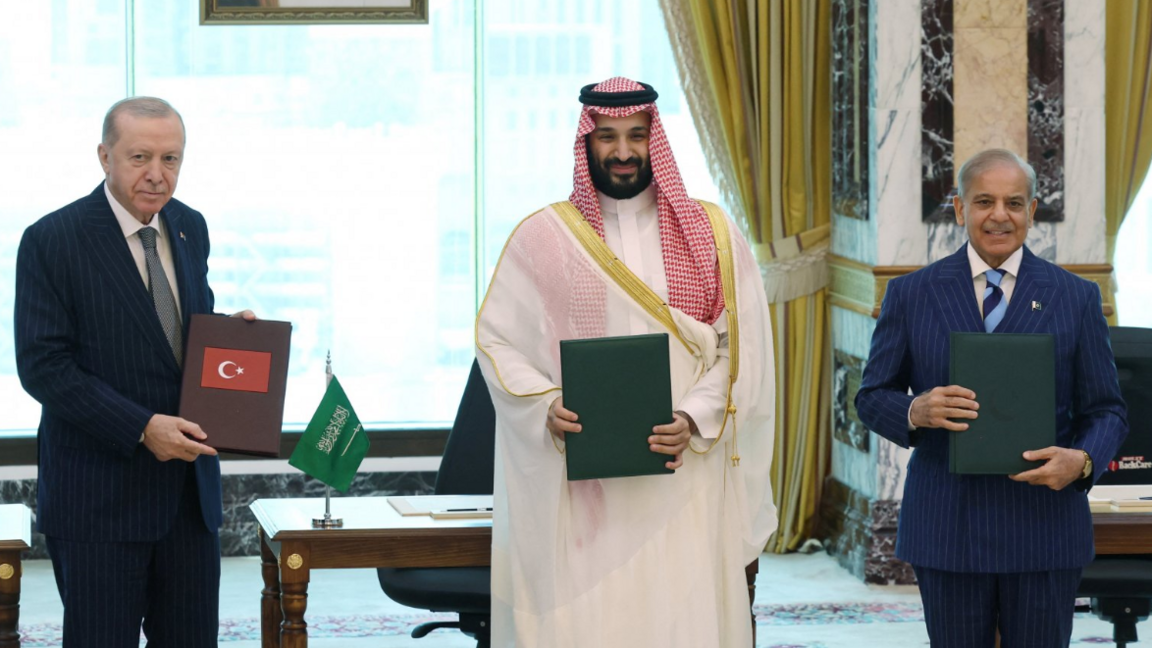
In a rare display of trilateral cooperation, Saudi Crown Prince Mohammed bin Salman, Turkish President Recep Tayyip Erdogan and Pakistani Prime Minister Shehbaz Sharif signed a joint defence agreement in Mecca. The pact promises that an attack on any one of the three states will be considered an attack on all of them, thereby bolstering each country’s security posture amid recent escalations involving Iran, Yemen’s Houthi rebels and regional spill‑over tensions. While the treaty does not set out detailed obligations, it signals a strategic alignment that could reshape deterrence in the Gulf and Red Sea corridors. The move comes as Saudi Arabia seeks to counter the fallout of the US‑Israel strike on Iran, Pakistan taps its new allies for support after recent border skirmishes with India, and Turkey aims to leverage joint defence projects to boost its military industry.
Saudi Arabia, Turkey and Pakistan ink defence pact in Mecca, pledging that an attack on one is an attack on all.
The ceremony took place before Saudi Crown Prince Mohammed bin Salman, Turkish President Recep Tayyip Erdogan and Pakistani Prime Minister Shehbaz Sharif in the holy city of Mecca.
The pact follows the US‑Israel offensive on Iran in February that triggered Iranian attacks on Saudi targets, a surge of shelling in the Strait of Hormuz and strategic pressure on Yemen’s Houthi militants.
In Tehran, a senior National Security Commission member warned that the trio’s paperwork would not deliver real protection to the Saudis. “Paper agreements work little, especially after years of unilateral U.S. pressure,” the MP noted on X.
Saudi Arabia and Pakistan had already formalised a mutual defence agreement last year, but the new alliance now includes Turkey for the first time.
Senior officials say the accord “strengthens collective deterrence against any act of aggression,” and it stipulates that any armed attack on one of the three states will be treated as an attack on all.
Despite its broad language, the treaty provides no clear mandates on how the partners will respond, suggesting that the commitment is largely symbolic and defensive.
Turkey stands to gain joint production and technology sharing opportunities with two large industrialised allies, whereas Pakistan seeks the stability and support of a united front in its long‑standing rivalry with India.
Saudi Arabia looks to the pact as a safeguard against a potential reignition of the war with Yemen’s Houthi forces and ongoing micro‑abrasions in the Gulf.
The alliance raises complex questions, such as whether Turkey would be expected to join Saudi air strikes in Yemen or whether Saudi would feel obliged to defend Pakistan against an Indian incursion.
In practice, the real impact of the pact will be governed by the delicate balance of strategic interests and careful diplomacy, with the primary likely outcome being an elevated deterrent effect for all three countries.
With a trio of powerful Muslim states backing one another, the cost of any aggressive move in the region is projected to rise, even if the threat can never be fully eliminated.