Russia has confirmed that it used the Oreshnik ballistic missile as part of a massive overnight strike on Ukraine on Thursday night.
Four people were killed and 25 others injured in Kyiv, where loud booms could be heard for several hours, setting the sky alight with explosions.
This was only the second time that Moscow has deployed the Oreshnik, which was first used to strike the central city of Dnipro in November 2024.
Russia's defense ministry stated that the attack was a response to a Ukrainian drone attack on Vladimir Putin's residence in late December, which Kyiv has denied carrying out.
While the ministry did not specify the exact target of the Oreshnik, footage emerged on social media showing several explosions near the western city of Lviv shortly before midnight (22:00 GMT).
Ukrainian authorities confirmed that a ballistic missile had struck infrastructure in Lviv, approximately 60km (40 miles) from the Polish border.
The Oreshnik missile is an intermediate-range, hypersonic ballistic weapon that can reach up to 5,500km (3,417 miles). It is believed to have a warhead that fragments during its final descent, causing multiple independent explosions.
Ukrainian foreign minister Andrii Sybiha labeled the strike near the EU and NATO border as a serious threat to European security, dubbing it a test for the transatlantic community. He criticized the attack as a reaction to Putin's perceived threats.
The strike has been met with skepticism, with the EU casting doubt on the Ukrainian drone attack's occurrence, and former President Donald Trump also questioning its validity.
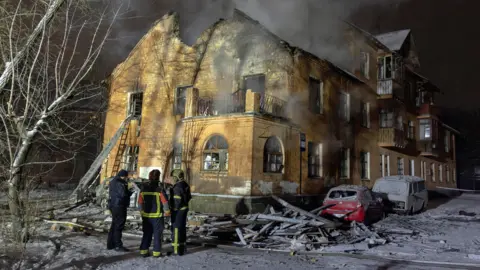
As the strikes intensified, over a dozen missiles and hundreds of drones targeted Kyiv. Among the casualties was a paramedic who was responding to an earlier attack when a second missile hit, commonly referred to as a 'double-tap' attack.
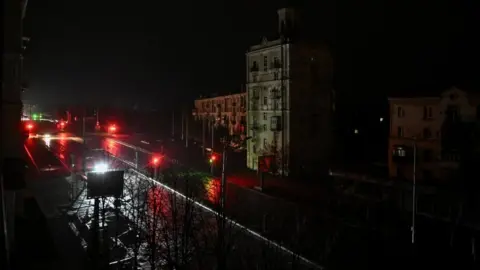
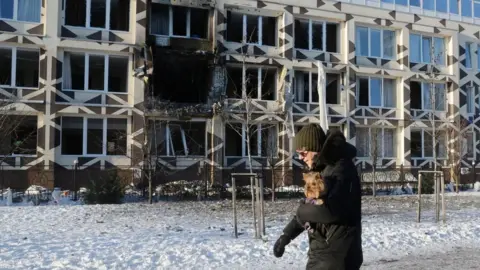
Significant infrastructure, including apartment buildings and power supplies, was affected, disrupting services during harsh winter conditions, where temperatures are expected to drop to -15C (5F).
In retaliation, Ukrainian strikes left half a million people in Russia's Belgorod region without power following shelling of local infrastructure.